

your tears are not weakness
Thursday 7.23.26 | Psalm 119:129-136; Psalm 128 | Proper 12A

your tears are not weakness
Thursday 7.23.26 | Psalm 119:129-136; Psalm 128 | Proper 12A
TL;DR: Psalm 119 puts real tears in the middle of a poem about devotion, not as a failure but as evidence of a heart that still refuses to look away. Your grief over a broken world isn’t a failure of faith. It is what happens when you remain awake to suffering and still care enough to be moved by it.
Read Psalm 119:129-136; Psalm 128
the liturgy of the mouth
Psalm 119 uses a strict acrostic structure. Every eight verses starts a new section, and every line in that section begins with the same Hebrew letter, working straight through the alphabet from beginning to end.
Today’s section centers on the letter Pe.
Pe is the Hebrew word for mouth.
This isn’t abstract theology; it’s emotional.
Mouth, throat, feet, eyes.
The psalmist names each one because devotion isn't an idea. It happens in a body.
gasping, not composed
“I open my mouth and pant, because I long for your commandments.”
— Psalm 119:131 (NRSVue)
Pant.
In Hebrew this is the word for someone running hard or hauling something heavy. Gasping. Out of breath.
Panting.
Most of us were taught faith should look calm. Sit still, fold your hands, keep your voice even.
This verse doesn’t do that. It shows a body that’s been pushed too far, mouth open, chest heaving, straining for something it can’t reach yet.
If your prayers lately sound more like gasping than sentences, you’re not failing at this. The most devoted person in the longest chapter of the Bible prayed the exact same way.
sisyphus and heaviness
For several years, I hardly cried.
There were moments when I wanted to. I could feel the grief gathering somewhere inside me, pressing against my chest and tightening my throat, but the tears wouldn’t come. I sometimes wondered whether I had become numb, or whether my body had simply learned to hold everything in because there was too much to feel.
That changed over the last year.
It began with the death of my youngest brother, Neil. Then came the steady progression of a systemic autoimmune disease with dysautonomia, and the slow unraveling of a life that had once felt relatively stable.
Now the tears come freely.
Sometimes they come because I miss my brother. Sometimes they come because my body no longer does what I ask it to do. Sometimes they come because ordinary things now require a kind of effort I can hardly explain. A meeting. A conversation. A Sunday morning. A walk across a room when the dizziness is bad.
There are days when suffering feels like something I’m trying to carry uphill. I put my shoulder against it, gather what strength I have, and push. For a moment, I think I might finally reach level ground.
Then it rolls back over me.
The ancient Greeks understood that feeling. In the story of Sisyphus, a man is condemned to push a stone up a hill, only to watch it tumble back down each time he nears the top. The punishment isn’t simply the weight of the stone. It’s the repetition. It’s having to begin again when you have already spent everything you had.
Chronic illness can feel like that. So can grief.
You work hard to reach some fragile place of balance, and then another symptom appears, another loss settles in, another piece of the life you knew slips from your hands. The stone rolls down. Morning comes. You place your hands against it again.
I don’t think my tears mean I’ve become weaker.
I think they mean my body has finally stopped pretending this isn’t heavy.
They are grief leaving the body in the only language it knows. They are love for my brother that still needs somewhere to go. They are the ache of losing parts of my life before I was ready to release them.
Some days, tears are the most honest prayer I have.
a flood of tears
The poem keeps going, and it moves from the mouth to the eyes.
“My eyes shed streams of tears because people do not keep your law.”
— Psalm 119:136 (NRSVue)
The Hebrew word for “streams” is palgey, the same word used for irrigation channels.
Real water. Enough water to cut a path through the ground.
Not a single tear. A flood.
I keep thinking about the stone I have been carrying the last year. It is so heavy.
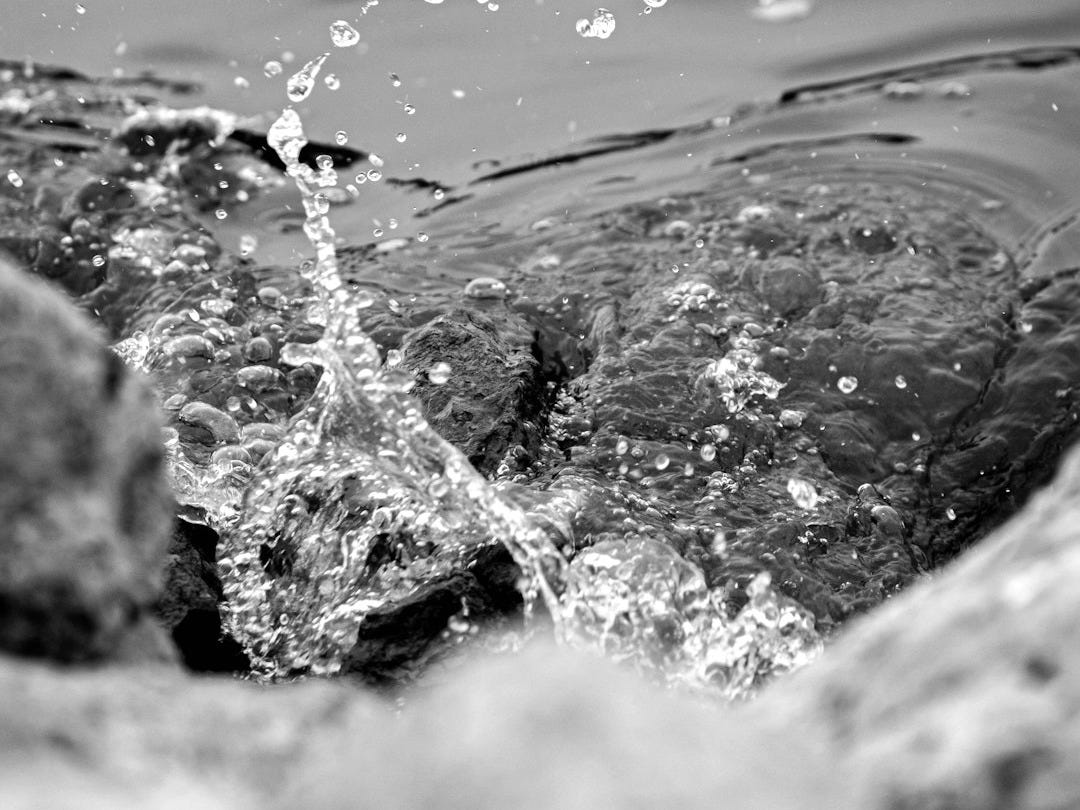
Tears may not be strong enough to lift it or stop it from rolling back down the hill. But water has its own kind of strength. Given enough time, it wears away even stone. Drop by drop, it finds the smallest opening and begins to make a way through what once seemed solid.
Maybe tears do that too.
They cut small channels through the grief we cannot move. They soften the places suffering has hardened. The tears give sorrow somewhere to go when we can no longer carry it silently inside us.
The stone may still be heavy. The hill may still be steep.
But neither remains completely untouched by our tears.
The psalmist isn’t crying over his own guilt. He’s crying because he keeps watching people choose what hurts them, and he can’t stop them. This isn’t self-pity. It is the cost of staying open to the pain around you instead of numbing yourself to it.
Church culture often treats tears like a problem. Someone cries on a Sunday morning, gets handed a tissue, and the service moves on.
This psalm does the opposite.
It puts weeping right in the middle of a poem about loving God, as though worship and grief come from the same tender place.
I know they do.
steady my steps
Somewhere in the middle of all that panting and weeping, the psalmist asks for one specific thing.
“Keep my steps steady according to your promise,
and never let iniquity have dominion over me.”
— Psalm 119:133 (NRSVue)
He doesn’t ask for a map. He doesn’t ask to see the whole road or get a guarantee about how it ends. He asks for footing on the ground where he is already standing.
The Hebrew word for “steps,” pe’amay, means a footfall. One step. Not the whole road ahead.
Maybe that is what we need when life feels like pushing a stone uphill.
We may not have the strength to reach the top. We may already know how it feels to watch the stone roll back down toward us, carrying yesterday’s grief, today’s pain, and tomorrow’s uncertainty with it. In those moments, the prayer is not always, “God, remove the hill.” Sometimes it is simply, “Keep my feet from slipping beneath the weight.”
Give me enough ground to stand on.
Give me enough breath for this moment.
Give me enough strength for one more step.
If you’re panting right now, or crying streams, or standing at the bottom of a hill you thought you had already climbed, you don’t need the whole picture. You need the next foothold.
Most people think prayer requires more than that.
On a difficult day, it doesn’t.
the quiet table
After all that gasping and weeping, Psalm 128 offers something almost jarringly plain.
“You shall eat the fruit of the labor of your hands;
you shall be happy, and it shall go well with you.”
— Psalm 128:2 (NRSVue)
That's the whole promise. The work of your hands feeds you. That's enough.
The psalm compares a spouse to a fruitful vine and children to young olive shoots around the table. This was written for people who’d already lost everything to empire once, who’d watched tax collectors take a season’s harvest out of their hands. For them, a table with food they grew, surrounded by people they loved, wasn’t a nice picture of home life. It was proof the empire hadn’t taken everything.
We live in a culture that calls “enough” a failure.
Psalm 128 says the opposite.
A table with real food and people who love you is the goal.
the whole body is welcome here
Read these two psalms together and you get an honest picture of faith. It’s panting through a prayer you can’t finish. It’s crying harder than you meant to. It’s asking for the next step instead of the whole plan. It’s sitting at a table with people you love, eating food you grew yourself, and calling that enough.
Your tears aren’t a problem to fix.
They are proof your heart still works.
Jesus wept beside the grave of his friend Lazarus.
And Revelation promises that one day God will wipe every tear from our eyes.
Until then, perhaps our tears are one of the places where God meets us most closely.
reflect
Where have you been treating your own tears as a failure instead of as evidence of a heart still paying attention?
What would it look like to ask for steady footing instead of a whole plan for what’s next?
Where is the “enough” already in your life that you’ve been taught to treat as not enough?
I so appreciate your writing and I know what you mean. I have wept every day for the past 2 years and I am getting better about not trying to fix the grief, rather - to just feel it. Peace
Tears, steps. We have today. Lord, what is mine to do today?