Where Light Takes Shape
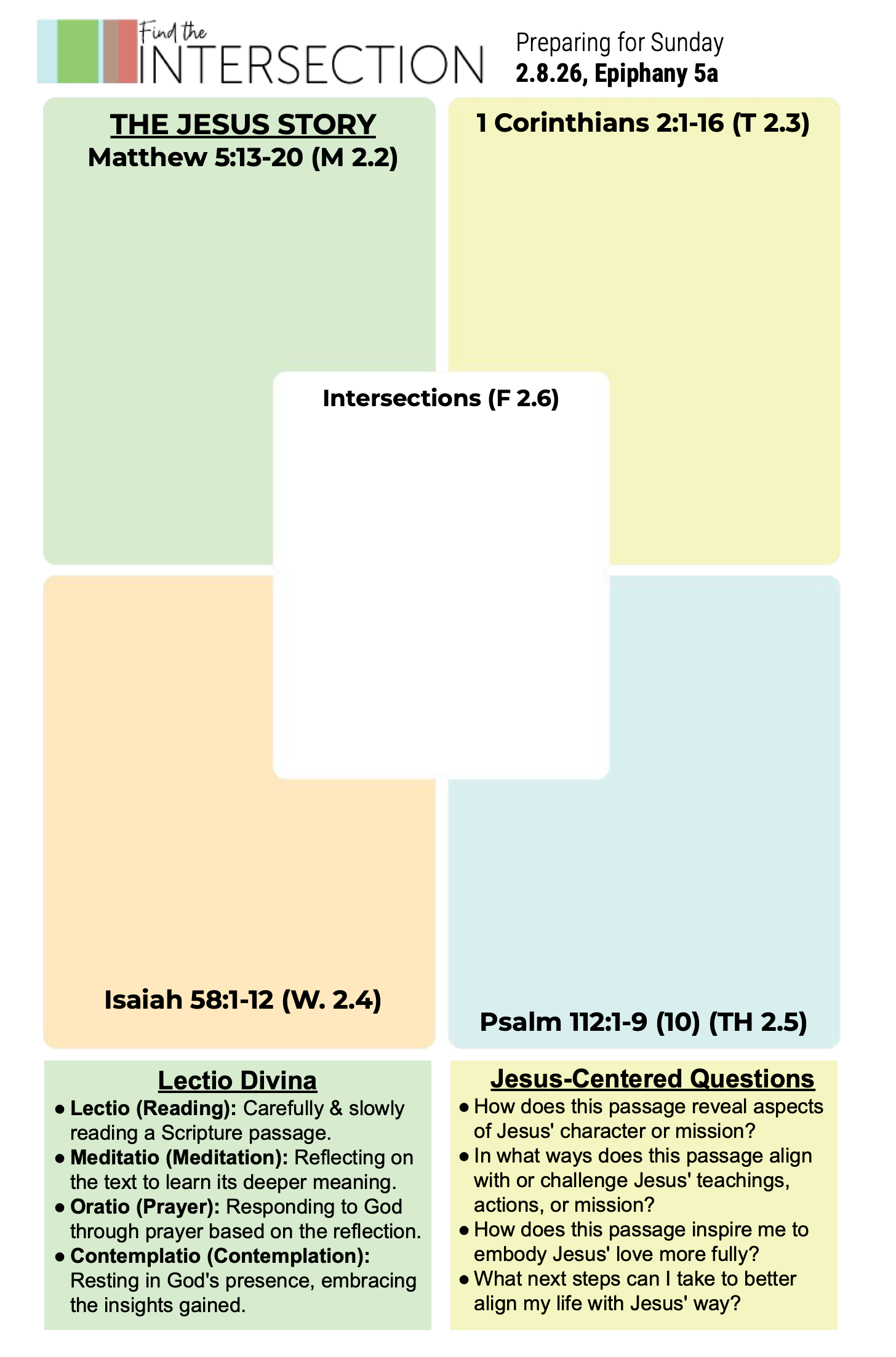
Friday, 2.6.26 - Find the Intersections
TL;DR: This week’s texts relocate holiness. God’s presence is found not in control, performance, or power, but in lives shaped by justice, generosity, and cruciform faithfulness. Light takes shape in vulnerable communities willing to be visible, to repair what has been broken, and to live another way in the world.
This Week’s Readings at a Glance
Matthew 5:13–20
Jesus names his disciples as salt and light, relocating holiness from sacred places to a vulnerable community whose visible faithfulness bears witness to God’s reign.
1 Corinthians 2:1–16
God’s wisdom is revealed not through eloquence or control, but through weakness, the cross, and shared dependence on the Spirit.
Isaiah 58:1–12
God rejects worship that leaves injustice untouched and redefines devotion as repair, release, and embodied solidarity with the vulnerable.
Psalm 112:1–10
Wisdom takes shape as a steady life marked by generosity, courage, and trust that does not panic when the world feels unstable.
Pulling Threads
When we start pulling threads, we find that the texts have been quietly relocating God.
Not away from the world.
But away from control.
What emerges is not a scattered set of threads,
but a woven reimagining of holiness itself.
God’s presence keeps moving.
And every move carries risk.
What follows are not five separate messages,
but five ways this week’s texts show us where light takes shape.
THREAD 1: From Sacred Centers to Ethical Margins
Isaiah begins by disrupting religious certainty.
God refuses fasting that leaves systems of harm untouched.
Worship that does not heal becomes theater.
God’s “Here I am” does not answer ritual precision.
It responds to bread shared, yokes broken, streets repaired.
Holiness is no longer anchored to devotion alone.
Holiness takes shape in solidarity.
Jesus intensifies the movement.
He speaks from a Galilean hillside, not the Temple courts.
He places Israel’s vocation not in sacred architecture,
but in a fragile community.
Salt and light are no longer metaphors for religious authority.
They are descriptions of people shaped by mercy, meekness, and hunger for justice.
Paul presses even further.
In Corinth, God’s presence is not just displaced from the center.
It is found in what the world names weakness. Fear. Trembling.
The cross.
A site of imperial execution becomes the place where divine wisdom is revealed.
Across the texts,
God does not retreat to the margins.
God reveals Godself there.
THREAD 2: Worship That Becomes Justice
These passages dismantle the lie that worship and ethics can be separated.
Isaiah names the fast God chooses.
It is not abstinence.
It is release.
Worship becomes credible only when it interrupts exploitation.
Psalm 112 echoes this vision quietly.
The one who fears the Lord is known not by prayer language,
but by economic faithfulness.
Lending without harm.
Generosity that stabilizes others.
Righteousness that lasts because it circulates.
Jesus makes the connection unavoidable.
Light shines through good works,
not to magnify the community,
but to redirect attention toward God.
These works are not generic kindness.
They are practices that resist domination
and make another way of life visible.
Here, ethics is not the aftermath of worship.
It is worship at its most truthful.
THREAD 3: Power Reimagined as Faithful Vulnerability
Each text confronts empire without becoming it.
Isaiah exposes clenched fists and pointing fingers as violence disguised as order.
Paul refuses rhetorical domination,
choosing weakness so faith will rest on God rather than performance.
Jesus offers influence without coercion.
Salt preserves quietly.
Light exposes without force.
Power, in these texts, is not the ability to control outcomes.
Power is the capacity to remain faithful without dominating.
Presence replaces pressure.
Integrity replaces spectacle.
Endurance replaces threat.
THREAD 4: Light as Dangerous Visibility
Light runs through the lectionary as promise and risk.
In Isaiah, light rises only after justice takes root.
In Psalm 112, light appears in darkness as steadiness, not triumph.
In Matthew, light cannot be hidden.
This is not safe illumination.
To be visible as an alternative community in an imperial world invites resistance.
Light exposes lies.
It unsettles systems built on fear and scarcity.
These texts do not romanticize visibility.
And they do not permit withdrawal.
Faithfulness does not retreat into privacy.
It stands. It shines. It risks being trampled.
THREAD 5: A Community Formed for Repair
The people imagined here are not defined by purity or success.
Isaiah calls them repairers of the breach.
Psalm 112 forms people who do not panic at bad news.
Paul speaks of a community shaped by the mind of Christ.
Jesus names them salt that must remain distinct or lose its purpose.
This is a people formed for the sake of the world.
Their holiness is functional.
Their faith is visible.
Their righteousness steadies others.
Holding the Tensions
These texts refuse easy resolution.
Grace is never separated from responsibility.
Healing never bypasses ruins.
Justice never becomes transaction.
Light never arrives without cost.
What they offer instead is a demanding hope.
A hope that insists transformation is possible.
A hope that refuses denial and domination alike.
MAIN THREAD: The World These Texts Create
Together, the passages call forth a counter imperial people.
A community willing to live in exposed places.
A people whose worship repairs streets,
whose generosity steadies neighbors,
whose weakness reveals God’s power,
and whose visibility bears witness to another way of being human.God’s kingdom is upside down, or perhaps rightside up,
compared to the ways of empire.
Light takes shape
in relocated holiness
in worship embodied as justice
in power emptied of domination
in risky visibility
in communities formed for repair
This is Epiphany light revealing the way things are.
It also gives us hope for the way things should be.
This light is apocalyptic. It reveals what is hidden and names what is real.
Epiphany does not ask us to admire this light. It asks us to live where it shines.
Let’s Talk
What thread did you find woven through the Scriptures this week?
How did these passages point you toward Christ?
How are they shaping you to live more Christlike this week?