


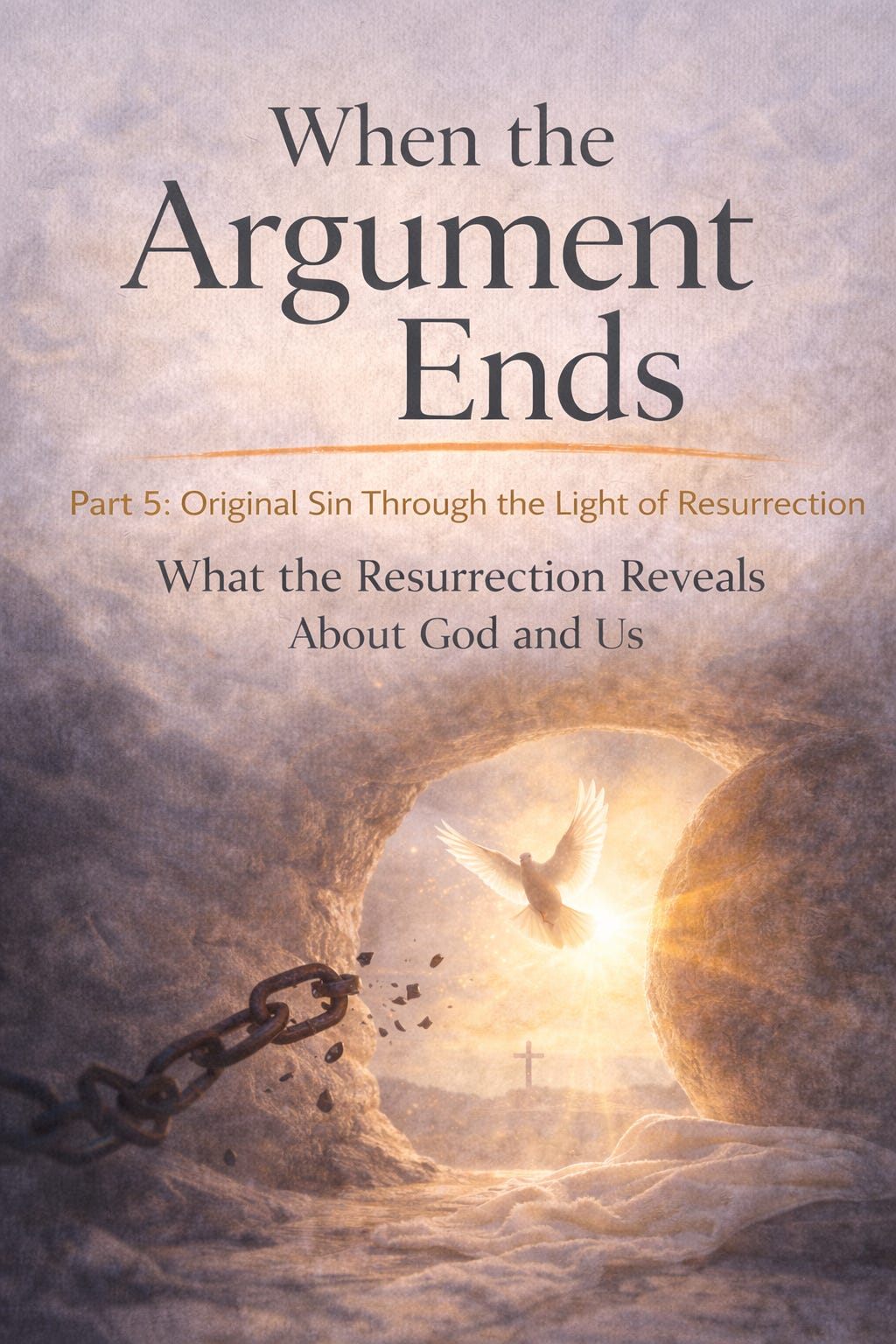
When the Argument Ends
Part 5: Original Sin Through the Light of Resurrection
What the Resurrection Reveals About God and Us
TL;DR: Human communities often stabilize themselves through rivalry, blame, and scapegoating. When tension rises, someone becomes the problem. The resurrection of Jesus exposes this pattern by revealing the innocence of the victim we condemned. But the resurrection does something even more surprising. The risen Christ returns not with accusation but with peace. The cycle of blame ends not with punishment but with mercy. And in that mercy we begin to discover a new way of being human.
The Pattern We Have Been Living Inside
Throughout this series we have been tracing a pattern that runs quietly through human history.
We begin by learning our desires from one another.
What others want begins to shape what we want.
Over time imitation becomes rivalry.
Rivalry spreads tension through families, communities, and nations.
Eventually the tension becomes unbearable.
And when that moment arrives,
human societies have discovered a predictable solution.
Someone must be blamed.
The scapegoat is identified.
The community unites against the victim.
Peace returns.
At least for a while.
This pattern has repeated itself across cultures, religions, and centuries.
Most of the time we never notice it while we are inside it.
The Moment the Pattern Broke
The crucifixion of Jesus followed this same pattern.
Rivalries were growing.
Religious leaders feared losing influence.
Political authorities feared unrest.
The crowd felt the pressure of uncertainty.
Eventually the solution appeared obvious.
Jesus became the problem.
If he were removed, stability could return.
If he were silenced, peace could be restored.
The crowd agreed.
The authorities agreed.
The system moved forward.
Another scapegoat.
Another victim.
Another moment when a community regained its unity by directing blame toward one person.
But then something happened that had never happened before.
God raised the victim.
When the Victim Is Vindicated
The resurrection shattered the story everyone believed.
The one condemned as dangerous was revealed to be innocent.
The one blamed for the chaos was vindicated.
Suddenly the entire mechanism of accusation was exposed.
The peace the crowd had created was not justice.
It was misunderstanding.
The unity they had achieved was not righteousness.
It was shared blindness.
For the first time in history the scapegoat mechanism was brought fully into the light.
What Everyone Expected
If the story ended there,
we might expect the resurrection to become a moment of judgment.
After all, the victim had been vindicated.
Surely now the guilty would be exposed.
Surely now the crowd would be condemned.
Surely now the risen Christ would return to confront those who abandoned him.
But that is not what happened.
The Words No One Expected
When the risen Jesus appeared to his disciples,
the first words he spoke were not accusation.
They were peace.
Peace be with you.
The ones who ran away were not rejected.
They were restored.
The ones who failed him were not condemned.
They were forgiven.
The victim refused to become the next accuser.
And in that moment the cycle of blame came to an end.
The Joy of Being Wrong
James Alison describes this moment as the joy of being wrong.
Because when the resurrection reveals that we misunderstood everything,
something unexpected becomes possible.
We no longer have to defend ourselves.
We no longer have to protect our fragile identities.
We no longer have to prove our innocence.
We can finally admit the truth.
We were wrong.
And instead of condemnation, we discover mercy.
The argument about guilt ends not because someone wins.
But because forgiveness arrives first.
A Different Story About Sin
For many of us the Christian story began with a different message.
We were told that the story begins with human failure.
Adam.
The fall.
Original sin.
But the resurrection invites us to see the story differently.
The story does not begin with sin.
It begins with goodness.
Creation is called good long before anything goes wrong.
Original sin is not the first truth about humanity.
And it is not that we were born hated by God.
The tragedy is something else.
We were born into patterns of rivalry, accusation, and shame that we did not create but quickly learn to repeat.
We inherit systems that teach us to compete for belonging.
To defend ourselves by blaming others.
To protect our identity by excluding someone else.
This is what the early Christians slowly began to understand in the light of the resurrection.
The Resurrection Changes Our View of God
But the resurrection does something even deeper than exposing our patterns.
It changes how we see God.
For centuries many people imagined God standing on the side of the accusing crowd.
A judge demanding punishment.
A ruler requiring sacrifice.
But the resurrection reveals something completely different.
God stands with the victim.
God vindicates the one the crowd condemned.
God exposes the violence we believed was righteous.
And when the risen Christ returns,
he does not join the crowd’s accusation.
He offers peace.
The resurrection does not reveal an angry God demanding vengeance.
The resurrection reveals a God who refuses to answer violence with violence.
A New Kind of Humanity
This is why the resurrection is not simply a miracle story.
It is the beginning of a new kind of human community.
A community that no longer needs scapegoats.
A community that no longer defines itself by who it excludes.
A community where identity is received rather than achieved.
Where belonging is not secured by rivalry.
Where mercy replaces accusation.
This is the community the early Christians began trying to live into.
And it is the community the gospel still invites us to become.
The Healing of the World
This is also why salvation cannot simply mean escaping the world.
The resurrection is about the healing of the world.
The healing of our rivalries.
The healing of our systems of blame.
The healing of our fragile identities.
The gospel invites us to become:
People who no longer need enemies in order to feel secure.
People who no longer protect our belonging by excluding others.
People who live from the mercy we ourselves have received.
The End of the Blame Game
The resurrection does not simply prove that Jesus was right.
It reveals something deeper.
God is not the author of the scapegoat mechanism.
God stands with the victim.
And if God stands with the victim,
then every system built on accusation begins to lose its power.
The blame game that has shaped human history is finally exposed.
And once we see it, we can begin to step outside of it.
The Story Comes Full Circle
The story does not begin with sin.
The story begins with goodness.
But when the light of resurrection shines on our history,
we begin to see the patterns we could not see before.
Rivalry.
Blame.
Scapegoats.
And once those patterns are exposed, a new possibility appears.
A humanity that no longer needs someone else to blame in order to belong.
Let’s Talk
Where do you see the scapegoat pattern still shaping our communities today?
What might change if we truly believed that God stands with the victim?
How might our relationships look different if we lived from belonging rather than rivalry?
The good news is not that we finally figured everything out.
The good news is that God’s mercy arrived before we did.
And that mercy is still inviting us to become the kind of people who no longer need someone else to blame in order to belong.
So true!