



the sorting hat lied to you
Friday 7.24.26 | Find the Intersections | Proper 12A
TL;DR: A deceptive wedding, an anxious throne, a groaning body, a full net. Every passage this week said the same thing: wait. Jacob got tricked into a marriage. Solomon got handed a kingdom he eventually ruined. Paul described a body too exhausted to pray in words. Jesus ended his parables with a dragnet full of fish nobody’s sorted yet. None of it got resolved by the end of the story. And maybe that is the point.
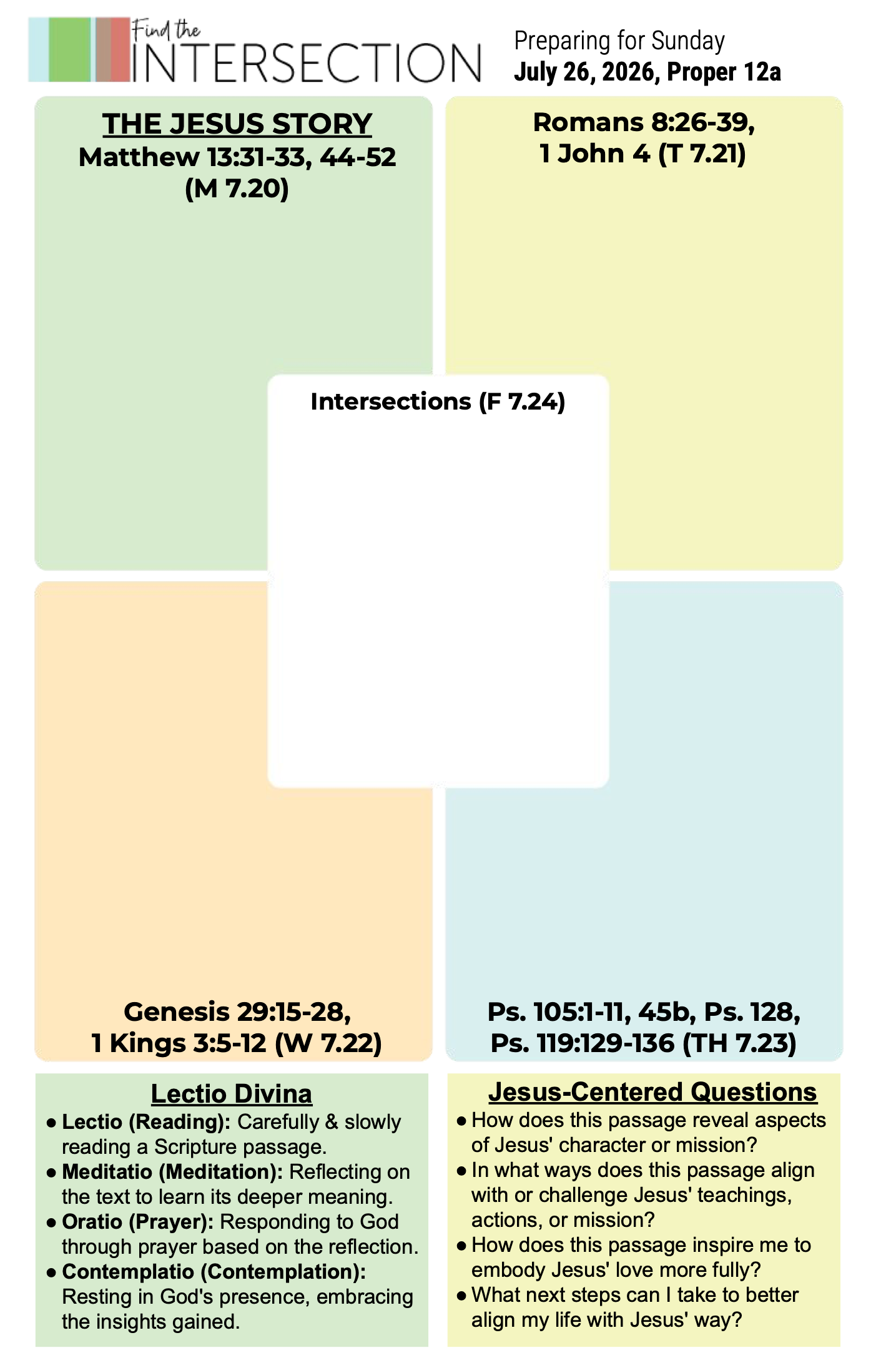
where we have been this week
Monday (Matthew 13:31-33, 44-52): Jesus tells a string of short parables about the kingdom of heaven: a mustard seed, yeast in flour, hidden treasure, a costly pearl, and a net thrown into the sea that catches fish of every kind.
Tuesday (Romans 8:26-39): Paul writes to an exhausted church in Rome about the Spirit interceding for believers with wordless groans. He follows this with the promise that nothing in all creation can separate them from the love of God.
Wednesday (Genesis 29:15-28; 1 Kings 3:5-12): Jacob works seven years to marry Rachel, and Laban substitutes her older sister Leah on the wedding night instead. Jacob confronts him and works another seven years, ending up married to both sisters. Later, Solomon, newly crowned and facing a fragile throne, has a dream at Gibeon where God offers him anything he wants. He asks for a listening heart to govern well, instead of wealth, long life, or the defeat of his enemies.
Thursday (Psalm 105:1-11, 45b; Psalm 128; Psalm 119:129-136): Three psalms move from a communal recital of God’s covenant history, to a quiet vision of an ordinary household at peace, to an intensely physical description of longing for God, complete with panting, tears, and a prayer for steady footsteps.
us versus them
We live in a country that has made tribalism the default setting for community. Pick a side. Draw the line. Decide who’s in and who’s out before the conversation even starts. That’s not an exaggeration. That’s just how a lot of us have learned to move through the world now.
The passages this week aren’t neutral on that. Watch what happens as we walk through them one at a time. Every single one has a moment where someone wants to sort the world into two groups, the acceptable and the unacceptable, and every single one refuses to let that sorting happen yet.
Maybe we need to retire the sorting hat.
the wage question
To trace this thread, we’re going to start at the beginning, in the first book of Scripture. Genesis 29 opens with a business deal, not a love story.
Laban’s first move is to ask Jacob what he wants to get paid. The Hebrew word is maskoret, wages. Before Jacob says a word about Rachel, Laban’s already thinking in terms of a transaction.
Jacob works seven years. He gets Leah instead of Rachel, in the dark, without his consent. He confronts Laban the next morning with the same word the Bible used for his own deception of his father: ramah.
The marriage that starts this whole story doesn’t get fixed by the end of it. Jacob works another seven years. Leah spends her life loved less than her sister. None of that gets resolved in Genesis 29. It just keeps going.
And notice the division already sitting underneath the whole story. Rachel is the favorite. Leah is the leftover. Genesis says it plainly: Leah was unloved, and she knew it. She names her first three sons hoping each birth will finally win Jacob over. Reuben. Simeon. Levi. By her fourth son she gives up on winning and names him for God instead. Judah, “this time I will praise the LORD.”
The competition between the sisters never gets resolved in real time. They spend years trading servants and bartering nights with their own husband, and nobody comes out of that with their dignity intact. But by the end of Jacob’s life, something has shifted. Rachel dies on the road and gets buried alone where she fell. Leah gets buried in the family tomb, next to Abraham and Sarah, Isaac and Rebekah. And Leah’s son Judah becomes the ancestor of David, and eventually, Jesus.
The sorting done on that wedding night, wanted versus settled for, gets quietly overturned by the end of the story. Just not on a timeline anyone watching could have predicted.
we won’t get fooled again
That kind of damage doesn’t stay in Genesis. It shows up again generations later, in a different book, in a different kind of crisis. Solomon becomes king when he was young, and the crown is not safe. His father just died. His brothers just tried to kill each other over this same throne. God shows up in a dream at Gibeon and offers him anything.
Gibeon is not a random location. Generations earlier, at Gibeon, the elders of Israel got conned by the Gibeonites, who faked a long journey with moldy bread and worn-out sandals to trick Israel into a treaty. Joshua 9 says: Israel didn’t ask God first. They trusted what they could see with their own eyes and got fooled.
Solomon doesn’t actually ask for wisdom, even though that’s the word most of us remember from this story. The Hebrew is lev shomea, literally a listening heart, a heart that hears and does something with what it hears. God’s answer back to him uses the word wisdom, but Solomon’s actual request was narrower and more relational than that. Solomon wanted the capacity to keep listening.
Solomon prays for that listening heart in the exact place his own people got deceived for not listening. That’s not a coincidence. That’s the point.
But hold onto this for later. The very next scene in 1 Kings is Solomon’s most famous moment: two women, one baby, each claiming to be the mother. Solomon has to sort a true claim from a false one with a child’s life on the line, and he gets it right, because he’s actually listening to God. That’s the listening heart in action, when it’s hasn’t been corrupted by other voices.
Decades later, the listening heart is still working. It just isn’t listening to God anymore. His wives turn his heart toward their gods and the same capacity that once made him a discerning judge now makes him an easy audience for foreign alliances, more wealth, more horses, more wives, everything his own law told him to avoid. The heart didn’t go quiet. It just started listening to someone else.
too raw for words
Solomon’s prayer at Gibeon was for a listening heart. That leads us to Paul, writing centuries later to a church that doesn’t have the words to pray at all. Paul writes to a fragile, exhausted church in Rome and doesn’t give them a pep talk. Paul names the problem directly.
“The Spirit helps us in our weakness; for we do not know how to pray as we ought, but that very Spirit intercedes with sighs too deep for words.”
— Romans 8:26 (NRSVue)
The Greek is stenagmois alalētois. Groans too raw to become words at all.
Paul doesn’t tell the church to get their prayers together. He says the Spirit is already praying inside the groan itself.
No sorting here either. No Christians who pray well and Christians who don’t. One Spirit, praying inside whatever a person’s body can actually produce that day, words or none.
both / and
And that leads us back to where we started this week. Monday’s Gospel reading is the text I want you carrying through everything else, the lens for the other three. Jesus ends his run of kingdom parables with a fishing net.
“The kingdom of heaven is like a net that was thrown into the sea
and caught fish of every kind.”
—Matthew 13:47 (NRSVue)
The net pulls in everything. Good fish, bad fish, all of it caught together. The sorting doesn’t happen when the fish are caught. It seems to happen later, at the end, by someone else. Or does it?
Every servant standing on that shore wants to sort now. They want to know which fish are theirs to keep and which ones get thrown back before the catch even finishes coming in. Jesus says wait.
Then Jesus closes the whole section with one more image, and it's easy to miss.
A scribe trained in the old law becomes a disciple, and Jesus says that scribe is like a homeowner who brings both new treasures and old ones out of the same storeroom. Not one instead of the other. Both, together, from the same shelf. Jesus isn't just delaying the sorting of good fish from bad. Here he refuses the sorting altogether. Old and new don't get separated into two piles either. They stay in the same storeroom because the house needs both.
Every parable in this stretch of Matthew was building toward the same point. Not either / or. Both / And.
the main thread
Four texts. Four unresolved situations.
A marriage built on a lie that doesn’t get untangled in the chapter it happens. A king handed power he’s not ready for, praying in the same spot his ancestors got fooled. A church too exhausted to form words, told the Spirit prays for them. A net full of fish that stays full and unsorted.
None of these get fixed by the end of the reading.
That’s not an accident.
That’s the point of the thread.
Every instinct says sort it now.
Fix the marriage by writing Leah off as the mistake and keeping Rachel as the real wife.
Solve the leadership crisis fast, with wealth and alliances, instead of the slow work of a heart that actually listens to God.
Sort the church into the people who can pray real words and the people who can only manage a groan.
Pull the net up early and separate the good fish from the bad before anyone else has to see the mess.
Here’s why I think Jesus tells them to wait, and it isn’t because he is going to separate us into us vs. them later.
We live in a country that has made tribalism the default setting for community. Pick a side, draw the line, decide who’s in and who’s out before the conversation even starts. And we bring that same instinct straight into how we read these texts.
We assume we’re Rachel, not Leah.
We assume we’re the wisdom-seeking Solomon of chapter three, not the compromised Solomon of chapter eleven.
We assume we’re the good fish, already sorted, just waiting for the net to open and confirm what we already knew about ourselves.
Solzhenitsyn wrote it after years in a Soviet labor camp:
“The line separating good and evil passes not through states, nor between classes, nor between political parties either, but right through every human heart.”
— Aleksandr Solzhenitsyn
Not us and them, not the wheat over here and the weeds over there. One line, running through every person, including the one holding the sorting hat.
Remember Solomon. He didn’t even ask for wisdom, not really. He asked for a listening heart, lev shomea, and God gave him exactly that. He used it well once, right at the start, sorting a true mother from a false one with a child’s life on the line. Then, decades later, that same listening heart was still fully working. It just wasn’t listening to God anymore. His wives had it. His alliances had it. His own ambition had it. The heart never went quiet. It just started listening to something else. If Solomon can ask for the right thing, receive it, use it well, and still end up on the wrong side of his own story, none of us gets to assume we’re already safely sorted into the good pile.
Jonah couldn’t accept that either. God sent him to Nineveh, a city he’d already written off, and when Nineveh actually repented, Jonah wasn’t relieved. He was furious. He wanted the sorting done immediately, on his terms, with Nineveh in the pile marked for destruction. He’d rather sit under a dead bush and sulk than watch God be patient with people he’d already decided didn’t deserve it.
That’s what the waiting is actually for. Not a delay before God finally sorts winners from losers while the rest of us watch safely. The waiting is how we find out we’re all made of the same material. We are wheat with weeds mixed into our own roots. We are the net, full of good and bad at the same time, not standing outside it sorting the catch. We are Solomon at Gibeon and Solomon at the end of his reign, both at once. We pray with real words some days and only groans on others, and both are prayers that our Abba is listening to.
The waiting doesn’t divide us into camps.
The waiting reminds us we were never anything but human, all of us, together.
No sorting hat.
One house.
All of us in it.
other threads
Deception keeps showing up, and it keeps costing someone else. Laban lies to Jacob and Leah pays for it with her whole life. The Gibeonites lie to Israel’s elders and the whole nation gets stuck with a treaty nobody wanted. Two different books, two different centuries, the same pattern: a lie told by one person becomes a burden carried by someone who never agreed to it.
Every prayer this week starts from a place of not having it together. Solomon asks for wisdom because he doesn’t have it yet. Paul’s church can’t even form words. The mustard seed and the yeast both start too small to notice. Scripture keeps handing the good stuff to people who show up empty, not to people who arrive prepared.
Something small keeps outperforming something impressive. A mustard seed beats a cedar. A wordless groan does what eloquence can’t. A listening heart beats an army. This week’s texts keep picking the small, unimpressive thing over the obvious, powerful one.
reflect
What intersections / threads did you find this week as you studied the lectionary scriptures?
Where have you assumed the dividing line runs between you and someone else, instead of through your own heart?
What in your life have you been trying to sort or fix before it’s actually time?
Where has a past deception, yours or someone else’s, kept rippling outward longer than you expected?
What would it mean to trust that your wordless groan already counts as a finished prayer?
I trust my wordless groans a lot more than I trust my worded prayers. The Heart senses what the Spirit wants, the Head has to play catch up through the noise of everyday living.,
We pray, Lead all souls to heaven, especially those who have most need of thy mercy. That's for those on the other side of the line, and also for the other side of our own heart.