The Jesus We Step Over
Monday, September 22, 2025 – Luke 16:19–31
TL;DR: Jesus tells a story about a rich man who feasted while Lazarus starved at his gate. The tragedy wasn’t wealth, it was blindness. Today we risk the same blindness when we walk past Jesus at the margins while chasing influence, comfort, or religious power.
The Gate We Miss
Lately it feels like we’re drowning in division. Us vs. them. Right vs. left. Power vs. protest. Christian Nationalism claiming Jesus while cozying up to seats of influence. Each side loud, each side certain. But in all the noise, I wonder: who is being stepped over?
When Jesus tells of the rich man and Lazarus, he isn’t just sketching heaven and hell. He’s exposing the tragedy of blindness, the way we build gates to protect our lives, our beliefs, our comfort, and miss the suffering lying right outside.
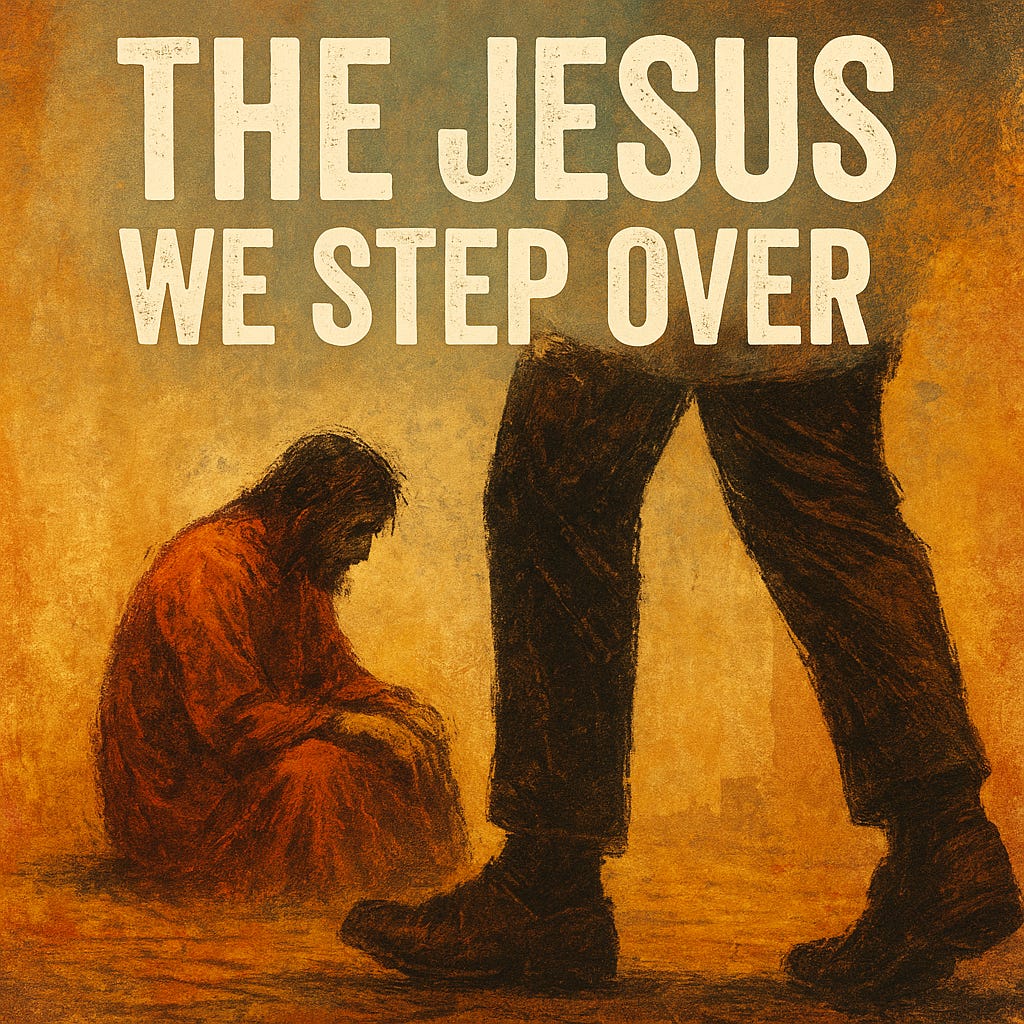
I think about where Jesus places himself in this story. Not in the palace. Not at the head table. Not in the robes of wealth and honor. Jesus is Lazarus at the gate. The one whose wounds make the powerful uncomfortable. The one whose hunger goes unanswered. The one ignored on the way to another banquet.
That’s what haunts me: how easy it is to step over Jesus on the way to sit with the powerful. How quickly religion blesses the feasts of wealth and influence while the Messiah waits in the dust.
Context: Setting the Scene
Historical Context
In the ancient world, purple cloth was reserved for the elite, dyed with materials so costly they became symbols of extreme privilege. Feasting “every day” was a mark of status that few in first-century Palestine could imagine. Meanwhile, Lazarus — his name meaning “God helps”, was covered in sores, lying outside the rich man’s gate. Hospitality was not optional in Jewish life; it was central to Torah faithfulness. To ignore Lazarus was not only callous but a violation of the covenant to care for the poor.
Literary Context
This parable comes at the climax of Luke 16, a chapter filled with teachings about money and stewardship. Just before this, Jesus told the parable of the dishonest manager and declared, “You cannot serve both God and money.” The story of the rich man and Lazarus becomes the living, painful example of what it looks like when someone serves wealth instead of God, building walls of indifference that become chasms of separation.
Theological Context
The point of the story is not to give a literal map of the afterlife but to reveal how our choices here shape our souls. The “great reversal” that Luke emphasizes throughout the Gospel is on full display: the lowly lifted, the mighty brought low. The chasm of death only makes visible the blindness that was already there. And in the end, the refusal to see Lazarus is the refusal to see God.
Luke 16:19–31 (NLT)
Jesus said, “There was a certain rich man who was splendidly clothed in purple and fine linen and who lived each day in luxury. At his gate lay a poor man named Lazarus who was covered with sores. As Lazarus lay there longing for scraps from the rich man’s table, the dogs would come and lick his open sores.
“Finally, the poor man died and was carried by the angels to sit beside Abraham at the heavenly banquet. The rich man also died and was buried, and his soul went to the place of the dead. There, in torment, he saw Abraham in the far distance with Lazarus at his side.
“The rich man shouted, ‘Father Abraham, have some pity! Send Lazarus over here to dip the tip of his finger in water and cool my tongue. I am in anguish in these flames.’
“But Abraham said to him, ‘Son, remember that during your lifetime you had everything you wanted, and Lazarus had nothing. So now he is here being comforted, and you are in anguish. And besides, there is a great chasm separating us. No one can cross over to you from here, and no one can cross over to us from there.’
“Then the rich man said, ‘Please, Father Abraham, at least send him to my father’s home. For I have five brothers, and I want him to warn them so they don’t end up in this place of torment.’
“But Abraham said, ‘Moses and the prophets have warned them. Your brothers can read what they wrote.’
“The rich man replied, ‘No, Father Abraham! But if someone is sent to them from the dead, then they will repent of their sins and turn to God.’
“But Abraham said, ‘If they won’t listen to Moses and the prophets, they won’t be persuaded even if someone rises from the dead.’”
Key Insights
1. Jesus Is at the Gate, Not the Feast
The rich man is nameless, but the beggar is named Lazarus. That reversal is intentional. In the world’s eyes, the rich man’s robes and banquets made him important; in God’s eyes, it was Lazarus who bore dignity and worth. Jesus places himself with Lazarus, not with the wealthy at the table. This should unsettle us. It means that when we look for Jesus in the halls of power or in the seats of privilege, we’re looking in the wrong place. Jesus is waiting in the places we’d rather not go.
2. The Gates We Build Become Chasms
The gate the rich man built to keep Lazarus out eventually becomes the chasm that keeps him from crossing back. What seems like a manageable boundary in life, a gate, a wall, a locked door, turns into an uncrossable divide. The story reminds us that the divisions we tolerate now, between rich and poor, insider and outsider, shape the world to come. The walls we build in life create the chasms we will one day lament.
3. Religion Can Bless Our Blindness
The rich man still calls Abraham “Father.” He still sees himself as part of the faith. But even in death, he treats Lazarus as someone beneath him, asking Abraham to send Lazarus like a servant. This is a haunting warning: religious identity can mask our blindness. We can call ourselves faithful, attend church, quote Scripture, and still fail to see the image of God in the one suffering at our gate.
4. Resurrection Isn’t Enough Without Love
The rich man begs for a miracle to warn his brothers. Abraham insists they already have Moses and the prophets. If they won’t listen, even resurrection won’t change them. Jesus is foreshadowing his own resurrection, and warning us that miracles alone cannot break hardened hearts. If love is absent, even the most dazzling sign will not move us. Transformation comes not from spectacle but from compassion.
5. Hell Is Missing God in the Neighbor We Ignore
The torment of the rich man is not arbitrary fire. It is the searing realization that he has missed God’s presence all along, in Lazarus, in his brothers, in the prophets. Hell is not simply a place after death but a condition of missing God in this life. When we ignore the vulnerable, we ignore Christ himself. And the torment is discovering, too late, that heaven’s banquet was always open, but only if we were willing to open our gate.
Jesus-Centered Questions
Who might be Lazarus at your gate today, someone you’ve been tempted to overlook or step over?
How do the “gates” of comfort, ideology, or busyness keep you from noticing Jesus at the margins?
What would it look like for you this week to tear down a wall and set a table instead?