


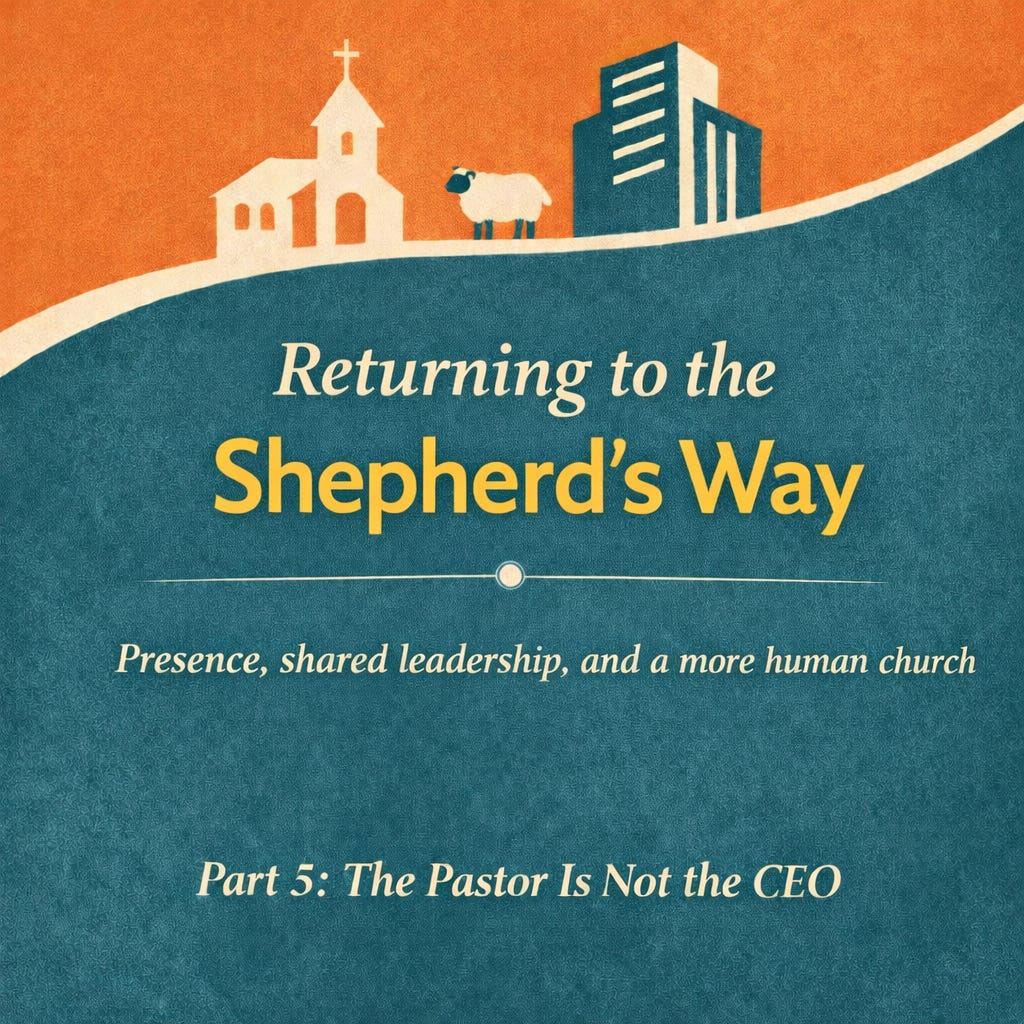
Returning to the Shepherd’s Way
Presence, shared leadership, and a more human church
Part 5: The Pastor Is Not the CEO
TL;DR: The way forward is not a new leadership model, but a recovery of an old one. The church is renewed not by stronger vision-casters, but by shepherds who cultivate presence, trust the body, and refuse to lead alone. The future of the church depends less on performance and more on faithfulness practiced together.
Series Note: This is Part 5 of the five-part series The Pastor Is Not the CEO.
In Part 1, we traced how the pastor-as-CEO model emerged during the church growth era.
In Part 2, we named the human cost of that model, including burnout, moral injury, and family strain.
In Part 3, we turned to Scripture to examine how this model conflicts with the biblical vision of shared leadership and distributed gifts.
In Part 4, we explored how anxiety and overfunctioning keep pulling churches back toward centralized control.
This final post turns toward hope, not by offering a new model, but by pointing to a more faithful way of being the church together.
We Do Not Need a Better CEO
The church does not need a better CEO.
She needs shepherds who know how to walk with people.
Across this series, we have traced the rise of the pastor-as-CEO model, named its human cost, measured it against Scripture, and examined how anxiety keeps it in place.
What remains is the question underneath all of it:
If not this, then what?
The answer is not a counter-model.
It is a return.
The Shepherd’s Way Is Not a Strategy
The shepherd’s way does not scale easily.
It does not photograph well.
It does not promise rapid results.
Which is precisely why it has endured.
Eugene Peterson insisted that pastoral ministry is not about “getting things done for God,” but about attending to what God is already doing among a people.
Shepherds are not architects of outcomes; they are caretakers of presence.
That kind of leadership is measured differently:
By depth, not speed
By trust, not control
By shared discernment, not unilateral clarity
It asks pastors to resist the pressure to be impressive, and instead be faithful.
What Must Be Released
Returning to the shepherd’s way requires more than new language.
It requires letting go of expectations that never belonged to pastors in the first place.
If the pastor-as-CEO model is to loosen its grip, certain assumptions must be named and released, not symbolically, but practically.
Among them:
The expectation that pastors be experts in everything. Theology, finance, HR, technology, conflict resolution, strategy, vision, care; no one person can faithfully carry all of this without distortion.
The belief that clarity must always come from the pastor. Discernment is a communal practice. When clarity is centralized, the body forgets how to listen together.
The assumption that growth proves faithfulness. Growth may happen. Decline may happen. Neither is a reliable measure of whether a community is being formed in love.
The myth that speed equals effectiveness. Much of what the Spirit forms: trust, maturity, reconciliation - moves slowly.
Releasing these expectations does not weaken the church.
It creates the conditions for a healthier one.
Shared Leadership Without Losing Authority
Shared leadership is not leaderless leadership.
It is authority practiced differently, and more truthfully.
One of the deepest fears beneath the CEO model is that without centralized authority, the church will drift into chaos. But over the last two decades, many churches and Christian communities have been quietly experimenting with different ways of leading, not because they rejected leadership, but because the old model was no longer forming faithful communities.
JR Woodward describes this work not as replacing leadership, but as cultivating a missional culture, one shaped by shared practices of discernment, trust, and attentiveness to God’s presence. In this vision, authority is less about control and more about relationship. Leaders function not as heroic vision-casters, but as stewards who help communities listen, learn, and respond together.
In The Church as Movement, Woodward and Dan White document communities that have intentionally shifted away from pastor-centric leadership toward more shared and accountable forms of leadership. Rather than prescribing a single structure, they highlight common patterns emerging across diverse contexts:
Authority is shared across teams rather than concentrated in one role
Decisions are discerned communally rather than dictated unilaterally
Leadership remains accountable to the body and responsive to mission, rather than elevated above it
These experiments are not perfect.
They are not uniform.
And they are not easily replicated.
But they point to a consistent truth:
Returning to the shepherd’s way is not about abandoning leadership.
Returning to the shepherd’s way is about practicing leadership differently.
A Word to Institutions, Not Just Pastors
The future of the church will not be secured by asking pastors to carry more.
If this series were only about personal posture, it would fail its own diagnosis.
Pastors do not become CEOs in a vacuum. They are shaped by:
Hiring expectations
Evaluation metrics
Institutional anxieties
Systems that reward overfunctioning
If the church is serious about returning to the shepherd’s way, institutions must change alongside individuals. That means rethinking how success is measured, how leadership is supported, and how responsibility is shared.
Otherwise, we will continue to name the problem, while reproducing it.
Faithfulness in a Fragile Time
Faithfulness in this moment may look like:
Pastors who refuse to carry what belongs to the body
Churches that relearn how to listen and lead together
Slower decisions rooted in prayer rather than panic
Institutions that reward sustainability rather than heroics
None of this guarantees institutional success.
But it does cultivate something far more important:
A church that can endure without destroying its people.
Not a Program, A Posture
This series has not been an argument for abandoning leadership.
It has been an invitation to recover its soul.
The pastor was never meant to be the CEO. And the church was never meant to survive on the strength of one person’s clarity, stamina, or vision.
The future belongs to communities that learn again how to walk together,
with humility, patience, and trust in the God who has always been faithful.
For now, let this be enough:
The shepherd’s way is slower.
The shepherd’s way is shared.
And it is still the way Jesus leads.
Let’s Talk
What expectations of pastors might need to be released for shared leadership to take root?
Where could authority be practiced more communally in your context, without pretending one model fits all?
What fears surface when you imagine leadership that trusts the body more than control?
A Final Word
Thank you for walking through this series with me.
My hope has never been to offer a new model to adopt, but permission to release what was never ours to carry.
May you find or help create a church where leadership is shared, limits are honored, and love remains the measure of faithfulness.
Grace and peace.
Paul
— a wounded healer