


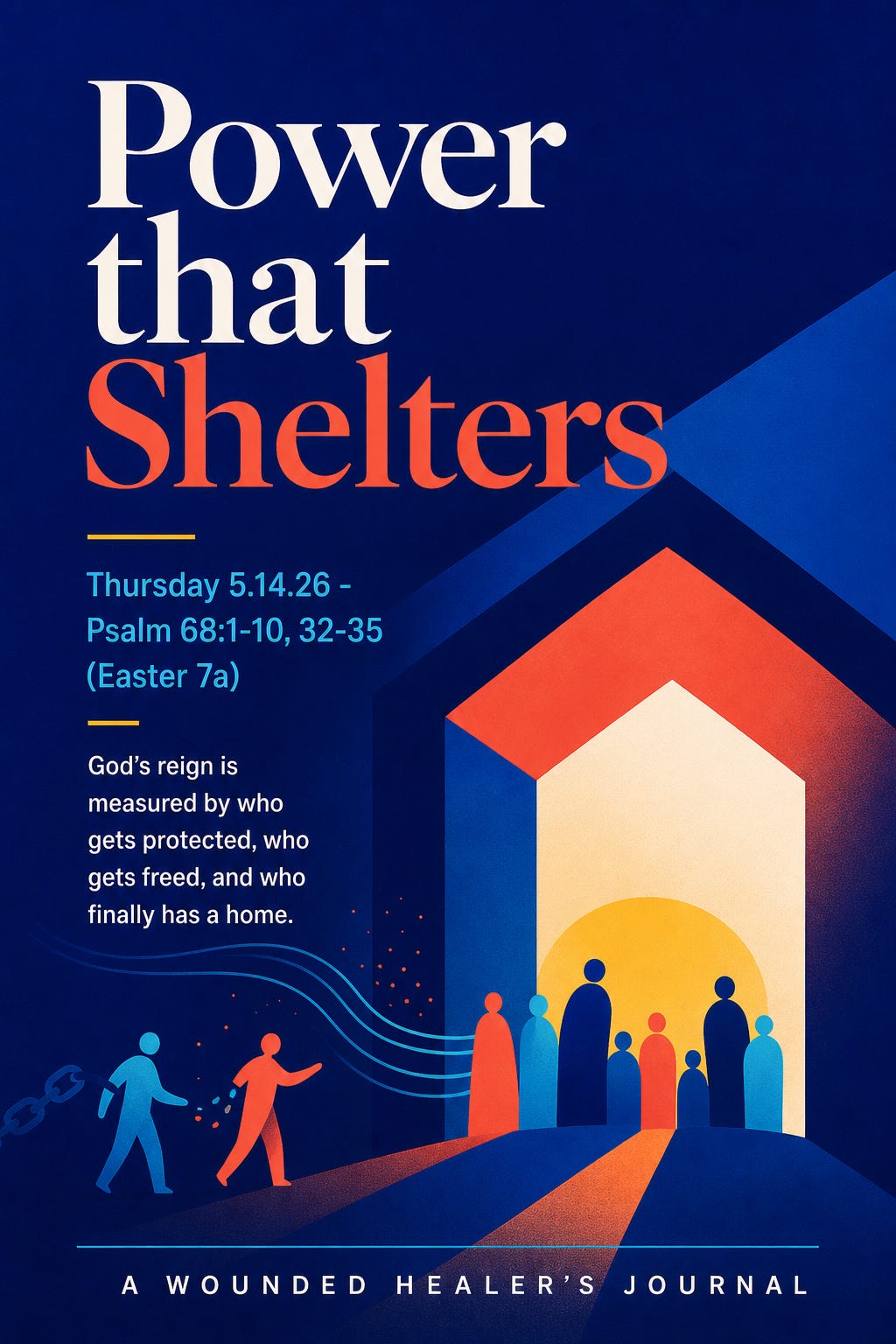
Power that Shelters
Thursday 5.14.26 - Psalm 68:1-10, 32-35 (Easter 7a)
God’s reign is measured by who gets protected, who gets freed, and who finally has a home.
TL;DR: Psalm 68 gives us a picture of divine power that does not look like domination. The God who rides upon the heavens is known by care for orphans, widows, prisoners, the desolate, and the needy. Ascension does not mean God has moved away from earth’s pain. It means love reigns over every power that harms.
God Gives the Empty a Home
About ten days ago, I had sinus surgery.
The official words are long: endoscopic excision of a left concha bullosa air cell and a left maxillary antrostomy.
In normal-person language, the doctor went in through my nose, removed an enlarged air pocket that was blocking things up, and opened my left sinus so it could drain and breathe better.
For the first four or five days, recovery felt like recovery. Not fun, but moving in the right direction. The swelling started to go down. The bruising began to fade. I started to think, Okay, maybe we are turning a corner.
Then Monday came.
I went back to the doctor for a follow-up procedure called a debridement, which basically means they clean out the healing area so the sinus can keep recovering properly.
They numbed my nose. The doctor started working.
And almost immediately, both of us knew something was wrong.
I squirmed in the chair. I made one of those involuntary sounds your body makes before your brain has time to be polite.
He stopped.
Then he told me the surgical area had not healed enough yet. We would have to wait and try again next week.
Since then, the pain has been severe. I have barely slept. The brain fog has been thick. The fatigue from Sjogren’s has been brutal. And honestly, it has all been deeply frustrating.
I am learning, again, that healing does not always move at the pace I want it to. Especially with autoimmune stuff in the mix, my body often needs more time than I think it should.
And I hate that.
There have been seasons when I did not feel strong enough to be impressive.
Illness has a way of doing that.
It shrinks your world a little. It makes ordinary things feel heavier than they used to feel. It teaches you the strange vulnerability of needing help, and the quieter fear underneath it:
What if I become too much?
What if I cannot keep up?
What if my weakness changes the way people see me?
I have felt that in my body this week. The frustration of needing help. The grief of not being able to do what I used to do in the way I used to do it. The awkwardness of receiving care when some part of me still wants to be the one who gives it.
I feel empty.
And in moments like this, I do not need someone to make me impressive again.
I need shelter.
I need patience.
I need a place where I do not have to perform wellness in order to belong.
That is why one line in Psalm 68 stops me every time:
“God gives the desolate a home.”
Not a lecture.
Not a productivity plan.
Not a spiritual pep talk.
A home.
Trusting Power
Psalm 68 begins with force:
“Let God rise up, let his enemies be scattered.”
That is not exactly a quiet opening.
It sounds like battle.
Smoke. Fire. Something being driven away.
And I want to be honest: power language is hard for me to trust.
I have seen power used badly.
Religious power.
Family power.
Political power.
Church power.
The kind that protects itself and calls it wisdom.
The kind that wounds people and calls it order.
So when a psalm starts with God rising up and enemies scattering, we need to read carefully.
In Christ, we do not get to turn our opponents into God’s enemies.
We learn to name the powers that scatter, shame, devour, and dehumanize.
Because the psalm itself tells us what God’s power is for.
What Power Does
God is “father of orphans and protector of widows.”
God gives the desolate a home.
God leads prisoners out.
God provides for the needy.
God sends rain in abundance.
God gives the weary flock a place to dwell.
That is the center.
The God who rides upon the clouds is not a tyrant in the sky.
The God who reigns over the heavens bends toward the exposed and worn-out places on earth.
This is power healed by love.
Not domination.
Not religious muscle.
Not the thrill of being stronger than someone else.
Power that shelters.
Power that frees.
Power that makes a home.
Power that notices dry ground and tired bodies.
The test of power is what happens to the vulnerable.
Psalm 68 says God’s power moves toward them.
The Desolate Get A Home
Salvation is not only future hope.
Sometimes it is the gift of finally having a place to belong.
I keep coming back to that line:
“God gives the desolate a home.”
Desolate is a heavy word.
It is more than lonely.
It is the ache of being exposed.
Uncovered.
Unclaimed.
Outside the circle of people who know where they belong.
Some people carry desolation in their bodies. You can see it in the shoulders. In the way they apologize for needing anything. In the way they stand near the edge of every room, ready to leave before they can be left.
And the psalm says God gives the desolate a home.
Not a lecture.
Not a test.
Not a spiritualized reminder that heaven will be better someday.
A home.
Salvation has walls and tables sometimes.
It has names remembered.
It has doors opened.
It has someone saying, “There is room for you here.”
Ascension Does Not Mean Distance
The God who reigns above the heavens is not far from earth’s pain.
This week keeps circling Ascension.
Jesus is lifted up.
A cloud takes him from sight.
The disciples return to the room and pray.
Psalm 68 sings of the God who rides upon the heavens.
But heaven, in Scripture, is not God moving far away.
Heaven is God’s reign.
God near in a way we cannot control.
God’s life holding the world from deeper than we can see.
Ascension does not mean Jesus has abandoned earth to the loudest powers.
It means the wounded and risen Christ is Lord over them.
And if Christ reigns, then power has a new definition.
Power looks like a towel and basin.
Power looks like wounds that refuse revenge.
Power looks like Spirit poured out on ordinary people.
Power looks like orphans protected, widows defended, prisoners led out, and desolate people brought home.
Praise As Protest
To praise the God who reigns is to tell every lesser power that it does not get the last word.
The psalm tells the kingdoms of the earth to sing.
That is not only worship.
It is also protest.
To sing that God reigns is to tell every lesser power the truth:
You are not ultimate.
You do not get the last word.
You do not own the vulnerable.
You do not define who belongs.
Praise can be a way of refusing despair.
Not pretending the world is gentle.
Not ignoring the harm.
But standing inside the harm and saying, “There is a deeper throne.”
And the one on that throne is not cruel.
The one on that throne gives strength to the people.
The Church Should Look Like Its Song
If we sing about shelter, our communities should become safe for the people God protects.
Here is where the psalm turns toward us.
If we sing to the God who gives the desolate a home, then the church cannot become a place where desolate people feel homeless.
If we worship the protector of widows and father of orphans, then our worship has to train our attention toward those who are exposed.
If we praise the God who leads prisoners out, then we cannot build communities that keep people locked in shame.
The church should look like the God it sings about.
It is possible to sing about shelter while becoming unsafe.
It is possible to sing about liberation while protecting control.
It is possible to sing about God’s power while using power in ways that do not look like Jesus.
Psalm 68 will not let us get away with that.
Strength For The People
The psalm ends with God giving power and strength to the people.
Not just displaying power.
Giving it.
Sharing strength.
Maybe that is the tender surprise.
God’s power does not make us smaller. It does not crush our humanity. It restores enough strength for love, truth, prayer, witness, and home-making.
This is what healing salvation feels like sometimes.
Not instant ease.
Strength enough to stand.
Strength enough to open the door.
Strength enough to tell the truth.
Strength enough to become shelter for someone else.
The God who rides the heavens is not far from the floor where people are trying to breathe.
God is there too.
Making room.
Giving strength.
Bringing the desolate home.
Let’s Talk
How does this passage point to Christ?
Christ reveals that God’s power is not domination, but sheltering love.
Christ is the wounded and risen Lord whose reign protects the vulnerable.
Christ gives the desolate a home through the beloved community he creates.
Christ leads people out of shame, captivity, and every power that dehumanizes.
Christ shows us that Ascension is not distance from earth’s pain, but reign over it.
Christ gives strength to the people so they can become signs of his liberating care.
How does this passage form Christlike people?
It teaches us to measure power by what happens to the vulnerable.
It forms us to protect the exposed, not admire the powerful.
It calls the church to become a home for those who feel desolate.
It trains our praise to become shelter, liberation, and concrete hospitality.
It exposes religious power that sings about love while making people unsafe.
It gives us strength to look like the God we worship.
So very sorry to hear that your recovery is not going well. Praying for you. 🥰🥰🙏🏻🙏🏻