



mercy with empty hands
Friday 6.12.26 - Find the Intersections (Proper 6A)
TL;DR: Jesus looks at exhausted people with compassion and sends ordinary disciples to offer the mercy they have received. Across this week’s readings, God meets us in weakness, carries us through wilderness, hears the cry that barely sounds like prayer, and reminds us that we belong to the Shepherd. Mercy reaches us before we know how to carry it. Over time, it becomes the way we love.
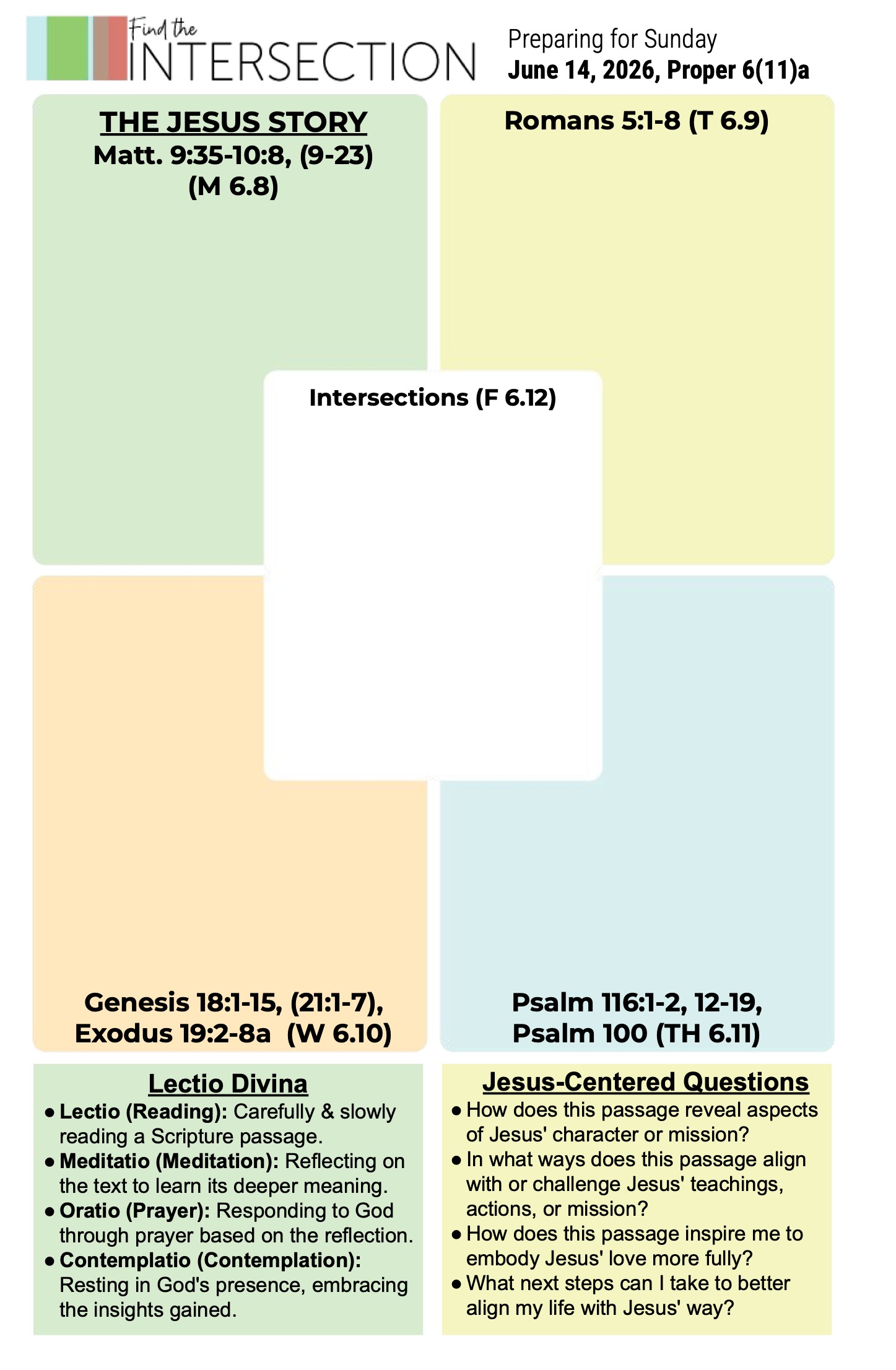
where we have been this week
In Matthew, Jesus looks at the crowds and sees people who are harassed and helpless, like sheep without a shepherd. His compassion moves through his body. Then he calls the disciples, gives them authority to heal, and sends them out to give freely.
In Romans, Paul says we have peace with God through Jesus Christ. God’s love has been poured into our hearts by the Holy Spirit, and Christ moved toward us while we were still weak. Love did not wait for us to get it together.
In Genesis, Abraham welcomes three strangers near the oaks of Mamre. He offers water, shade, bread, curds, milk, and a meal in the heat of the day. Sarah overhears the promise that she will have a child, and she laughs because the promise sounds impossible after years of grief.
In Exodus, Israel camps at Sinai after being freed from Egypt. Before God gives the people a vocation, God reminds them what has already happened: “I bore you on eagles’ wings and brought you to myself.” A people shaped by slavery are invited to become a treasured people, a priestly kingdom, and a holy nation.
In the Psalms, one survivor lifts the cup of salvation because God heard their cry. Then Psalm 100 invites the whole earth to worship because we are God’s people, the sheep of God’s pasture.
ordinary places are holy ground
The lectionary reading in the Hebrew Bible begins in a very ordinary place.
A tent. A tree. A meal. The heat of the day.
I keep expecting God to arrive somewhere more impressive than my family room. Somewhere with candles and stained glass. Somewhere that appears more sacred.
These days I am stuck in a chair at home with no energy to do much else. But yet, I’m surround by God’s presence even in the midst of my pain.
Genesis puts the Trinity in the dust as travelers who need food.
The promise comes through hospitality. It comes while bread is being made and a meal is being prepared. It comes while Sarah is listening from inside the tent, carrying years of disappointment in her body.
And when she laughs, God does not walk away. Some laughter is joy. Some laughter is protection. Some laughter comes from being disappointed too many times.
God loves his children, those who provide hospitality and those who do not. Those who pray and those who do not. And even those who laugh at the ridiculousness of the promise.
I am reminded that God loves me too, even here, even in my lament.
we are carried before we are called
Then Exodus takes us from the table to the mountain.
Israel has been pulled out of Pharaoh’s world, but they are not settled yet. They are free, and freedom is disorienting. Egypt was brutal, but it was familiar. The wilderness is open, strange, and hard to control.
So before God asks anything of them, God reminds them:
“I carried you.”
So much religion begins with obligation. Do better. Try harder. Become worthy. Prove you belong here.
Exodus starts somewhere else.
Before the calling, there is rescue. Before vocation, there is being carried. Before the people are asked to become a blessing for the world, God reminds them that they have already been brought near.
Wounded healers need to remember this. I can forget that I am carried. I can start believing I have to keep everyone else alive by effort, strategy, and sheer force of will. I can confuse calling with overfunctioning. I can confuse love with exhaustion.
God carries us out of systems that dehumanize. Then God teaches us how to carry mercy without becoming another version of Pharaoh.
love heals us while weak
Romans takes us deeper. Christ died for us while we were still weak. That sentence can undo a lot of toxic religion.
God’s love meets us before we know how to stand, before we know how to fix what is broken, before we know how to explain our own contradictions.
Love heals. Love puts us back together.
Shame keeps people hidden. Fear keeps people performing. Conditional acceptance keeps people managing their image.
Love that arrives while we are weak gives us permission to see that judgment is more like a diagnosis than what we realize. When we are loved while we are weak, broken, curved in on ourselves, we can find the strength to say, “yes” to God’s diagnosis and healing remedy.
I keep thinking about the old Christian image of the church as a hospital. Christ is the Great Physician. Sin is more than a list of violations. It is a wound. It is a sickness. It is all the ways love gets bent out of shape in us.
That image comes from the early church and the Eastern Christian tradition. The reformation turned the hospital into a courtroom, and we do not need another courtroom sermon that explains salvation as Jesus taking the punishment sinners deserve so God’s justice could be satisfied and sinners could be forgiven. (penal substitutionary atonement).
We need a doctor.
We need oil and wine.
We need a community where weakness is not treated like failure.
jesus trusts wounded people with healing
Then Matthew shows us Jesus.
He looks at the crowds and his gut aches.
The people are harassed. Thrown down. Worn out by powers that were supposed to protect them. They are sheep without a shepherd, which means they have had plenty of leaders and not enough care.
Jesus sees them as they are, in their pain and trauma.
Then Jesus does something surprising. He shares his work. He calls the twelve.
That list is a mess. There is a tax collector in the group. There is a zealot. There are people who misunderstand him, people who will run, and one who will betray him.
And still Jesus gives them authority to heal. I do not know how to make that sound normal. Jesus doesn’t keep the authority to heal to himself. He sends regular people, people who still do not understand him half the time, to share the mercy they have received.
And he sends them empty-handed. No gold. No silver. No extra bag. No way to control the outcome.
They have to enter homes. Receive hospitality. Depend on others. Offer peace. Heal freely.
Empire hoards power, protects itself, charges admission, and calls it security.
Jesus gives away mercy and tells his friends to travel light.
the thread
Here is what I keep seeing this week:
God meets wounded people in ordinary places. God loves us before we are strong. God carries us out of what is killing us. Then God asks us to become part of the healing of the world.
I see it everywhere this week.
Sarah’s tent.
Sinai’s wilderness.
Paul’s room of grace.
The crowds in Galilee.
The survivor lifting the cup.
The whole earth singing because we belong to the pasture.
These passages do not ask us to pretend the wound is tiny like a papercut.
Sarah’s grief is real. Israel’s trauma is real. Human weakness is real. The crowds are really harassed. The psalmist really cried out from trouble.
The good news is that God keeps moving toward the wound. And when mercy reaches us, it begins to move through us.
That is what wounded healers do. We are not untouched by pain. We are people Christ has met there.
So we carry what we have received, usually with trembling hands, and offer it without charge.
Maybe this is the invitation for the week:
Let God meet you in your laughter.
Let God carry you in the wilderness.
Let God love you while you are weak.
Let Jesus look at your exhaustion with compassion.
And when you are able, go with open hands. You do not have to be the savior. You only have to remember where the medicine comes from.
reflect
Where did you notice the main intersection this week?
Where are you being invited to receive mercy before trying to offer it?
What would it look like to carry free mercy into one ordinary place this week?
❤️. This week, I am working through old thoughts and feelings about my dad. My dad was wounded. And I am not sure he ever felt loved. When people drew close, he pushed them away with his words and actions. If you built a bridge, he eventually burned it down. My sister and I learned a conditional, odd sort of love growing up. We are wounded still.
Empty hands, open hands. There is something about your picture. Empty hands mean, “I have nothing to give you”. Open hands mean, “Come, let me welcome you with my open hands, open arms. The second requires an open heart.
THANK YOU for the context, the thread of intersection every week between lectionary readings.
Your comment today - “So much religion begins with obligation. Do better. Try harder. Become worthy. Prove you belong here.” - opens my eyes to the way I was formed in my church, and how I’ve continued to carry this.
While I am opening myself up to God’s love as shown in Jesus’s grace, compassion and help, I also believe Jesus did bear the punishment for my sin, and by His stripes I am healed. Jesus’s sacrifice for ours is the ultimate gift given out of God’s love for us.
I believe both statements are true. God is abounding in love and mercy and also righteous and just. Jesus demonstrated all of God’s nature/character for us.
It seems like people often gravitate toward one side or the other, God’s love or His judgment. Jesus spoke about both, but his actions were overwhelmingly compassionate and full of love and grace. Again, thank you for opening me up to this truth. I appreciate you!