


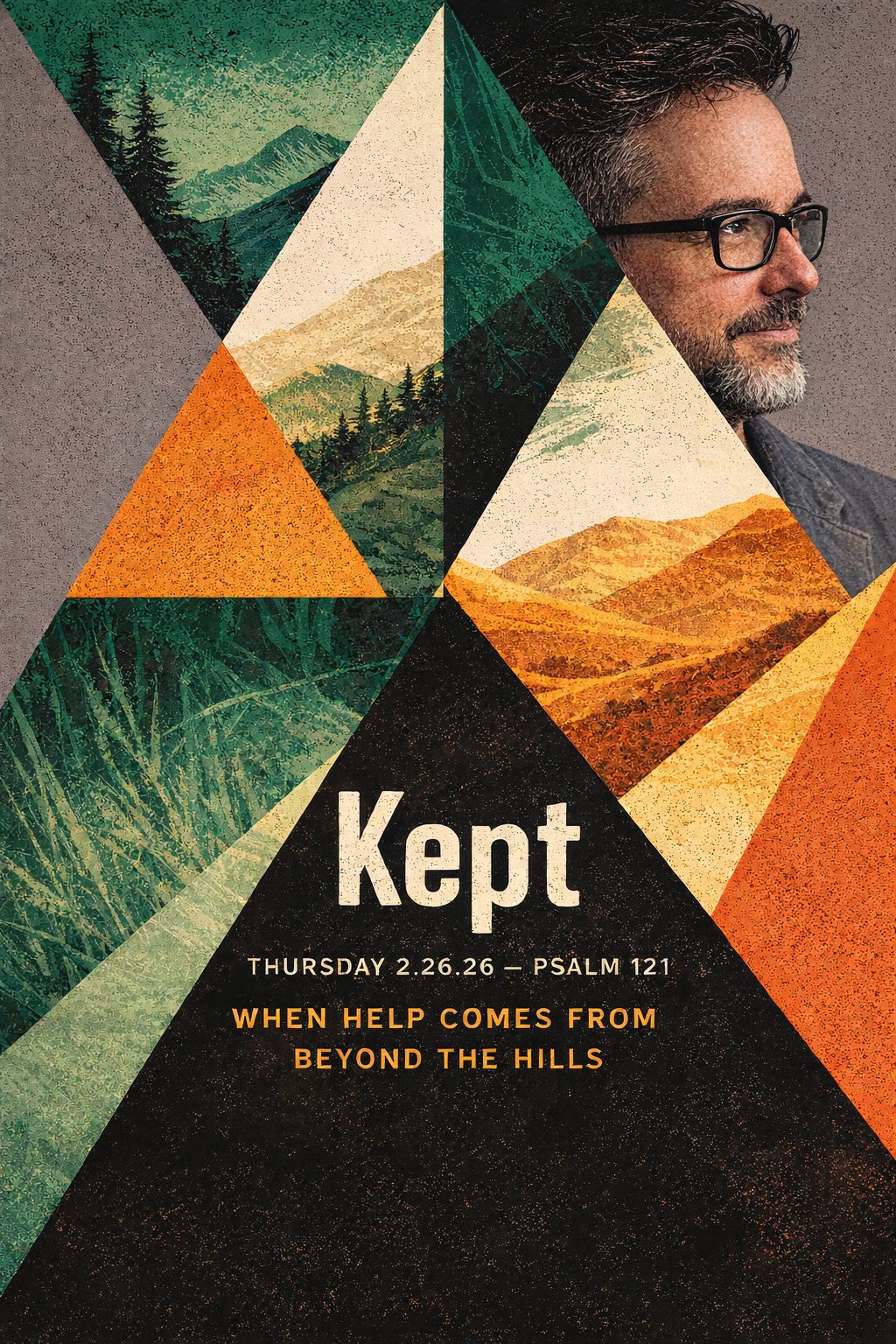
Kept
Thursday 2.26.26 — Psalm 121
When Help Comes From Beyond the Hills
TL;DR: Pilgrims sang this psalm on dangerous roads. Help does not come from hills, empires, or human strength. God is the Keeper who does not sleep. Protection is presence, not the absence of trouble.
When Help Comes From Beyond the Hills
“I lift up my eyes to the hills.
From where will my help come?”
If you have ever stood at the edge of something uncertain, you know that feeling.
The hills in this psalm are not soft watercolor landscapes.
For ancient pilgrims traveling to Jerusalem, hills meant exposure.
Bandits. Harsh sun. Wild terrain.
The journey to worship was not safe.
It required trust .
These were Songs of Ascent.
People sang them on the road.
Which means Psalm 121 was not written from a couch.
It was written from the path.
And the first line is not a declaration.
It is a question.
Where does my help come from?
It is an honest question in a world shaped by power.
In the ancient Near East,
mountains were often associated with divine presence.
High places held shrines.
Empires built monuments on heights.
Power liked elevation.
But the psalm refuses to locate help in the geography of awe.
“My help comes from the Lord, who made heaven and earth.”
Not from the hills.
Not from the empire.
Not from military might.
Not from self-reliance.
From the Creator.
That line would have carried quiet defiance in seasons when Israel lived under Assyrian, Babylonian, Persian, or Roman dominance .
While emperors claimed ultimate security,
this psalm redirected trust to the One who keeps.
And that word echoes.
Keep.
Keep.
Keep.
The Hebrew verb shamar repeats again and again.
To guard.
To preserve.
To watch over.
It is covenant language.
Not generic divine vibes.
The Keeper of Israel.
The God bound in relationship.
“He will not let your foot be moved.”
Anyone who has stumbled on loose stone understands that prayer.
“He who keeps you will not slumber.”
Ancient myths imagined gods who could be distracted, appeased, manipulated.
This psalm insists otherwise.
Your Keeper does not nap.
Your Keeper does not drift.
Your Keeper does not lose focus.
But here is where we must tread carefully.
This psalm is not a prosperity guarantee.
It does not promise a trouble-free life.
Pilgrims still faced heat and danger.
Israel still knew exile and suffering.
We still know illness and loss.
So what does “keep” mean?
It means presence in vulnerability, not exemption from it.
“The Lord is your shade at your right hand.”
Shade is not removal of the sun.
It is protection within exposure.
In desert climates, shade is survival.
It is intimate, close, steady care.
“The Lord will keep your going out and your coming in from this time on and forevermore.”
When the psalm says ‘your going out and your coming in,’
it’s naming both ends to mean the whole of your life.
Every departure.
Every return.
Every ordinary Thursday.
Every life-altering transition.
This psalm was sung communally.
“He who keeps Israel.”
Individual reassurance is rooted in shared belonging.
No one pilgrim walked alone.
Their voices braided together on the road.
There is something deeply tender about that.
In seasons when bodies fail.
When grief lingers.
When the political landscape feels unstable.
When anxiety hums at night.
We lift our eyes and ask the same question.
Where does my help come from?
Not from domination.
Not from noise.
Not from systems that promise safety through fear.
From the Keeper.
And trusting that is an act of resistance.
It refuses despair.
It refuses to bow to the loudest power in the room.
We are kept.
Not as possessions.
But as beloved people on pilgrimage.
Let’s Talk
How does this passage point to Christ?
How does this passage form Christlike people?
Sit with it.
The hills are still there.
But so is the Keeper.
Thanks, again, Paul. Yes, I think the first verse is often misread to say the it is the hill that provides help. Thank you for making that clear. (I’ve received push back on that in the past)
Amen, brother - the fortress is made of holy Presence and the power of God's grace, not commanding heights nor force of arms. A timely reminder, thank you! 🙏🙏