


Belonging Together
Part 2 of 5: Being the Church Together
Welcome is Not Enough, the Church Must Become a Family
TL;DR: Belonging is more than being allowed in the worship space. It is being received into the life of a people. Too many churches welcome attendance but never practice the kind of presence, honesty, and shared life that turns strangers into family. If belovedness is the starting point, then belonging becomes more than a slogan. It becomes a culture where people are known, held, challenged, and loved across real difference.
“There is something transformative and sacred in belonging. When we are received as we are, we can drop our defenses, breathe deeply, and trust that we don’t need to earn or deserve a place; that unlike so many other places we find ourselves, there are no prerequisites or qualifiers hindering us there, no hidden agendas waiting to ensnare us, no eventual bait-and-switch coming. If there’s anything spiritual community should do, it’s this. It should give people a sense of found-ness. People experienced this in Jesus’ presence, whether priest or prostitute, whether revered soldier or shamed pariah, whether confidently pious or morally bankrupt.”
— John Pavlovitz
We Were Made to Belong
“We all need belonging, because we were made to belong.”
— David Kim
A church can offer someone a seat in the sanctuary, without offering them belonging in the family.
There is a difference between finding an open chair as you scan the worship center, and finding your place to be known, to be valued, to be loved, and to belong.
Most of us know that difference in our minds, but we feel the difference in our bodies.
You can walk into a room and see plenty of empty seats, but still feel like there is nowhere for you to sit. You can be greeted at the door and still feel like nobody really saw you. You can sing the songs, hear the sermon, shake a hand or two, and still leave with the quiet ache that you were near something called community without ever being gathered into it.
That is what I keep thinking about as we move from Beloved Together to Belonging Together.
Belovedness is the truth underneath everything. You are loved by God before you prove anything. Before you become useful. Before you believe correctly. Before you know how to fit.
But if belovedness is true, then it has to become visible somewhere.
Belovedness has to become embodied.
It has to become a family room where people can be themselves, and just breathe.
That is where belonging begins.
Not with a membership form.
Not with a name tag.
Not with a handshake during the greeting time.
Those things are not bad. They can be good. But they are not the same as belonging.
Belonging is what happens when people are no longer treated like guests in someone else’s house.
They are received as family.
Welcome is Not the Same as Belonging
“Beloved Community is a place where we belong,
we are safe, we are welcome.”
— Lee & Fosua (A New Dawn in Beloved Community)
Welcome opens the door. Belonging makes a home.
A lot of churches say, “Everyone is welcome.”
Our church says it each and every Sunday.
I believe most churches mean it.
But welcome can still keep people at a distance.
Welcome can mean, “You may enter our space.”
Belonging means, “Your life matters here.”
Welcome can mean, “We are glad you came.”
Belonging means, “We would miss you if you were gone.”
Welcome can be polite.
Belonging has to become personal.
This is where churches often get stuck. We confuse friendliness with belonging. We confuse attendance with community. We confuse being nice to people with making room for their actual lives.
A person can be welcomed every Sunday and still never be known.
They can be invited to attend and never invited to belong.
They can be told, “We’re glad you’re here,” while also receiving a hundred quiet signals that they will only really belong if they become more like us.
That is the old pattern.
The world sorts people all the time. By race. By class. By politics. By education. By family structure. By usefulness. By taste. By comfort. By whether someone feels familiar enough not to threaten us.
The church is supposed to be different.
Not because difference is easy.
It is not.
But because Jesus keeps building a family out of people who would not have chosen each other on their own.
When Church Accidentally Keeps People Lonely
"Connection is why we're here. We are hardwired to connect with others, it is what gives purpose and meaning to our lives, and without it there is suffering."
— Dr. Brene Brown
Sometimes the church promises belonging, then hands people a program and hopes it works.
David Kim, in Made to Belong, describes something he calls the “Unintentional Church Cycle.” The phrase stuck with me because I think I have seen it. I have probably helped create it without meaning to.
It starts with a good invitation.
The church says, “You belong here.”
The lonely person believes it enough to show up.
Then the church offers the usual pathway:
Join a small group.
Serve on a team.
Support the mission.
Come to more things.
Get involved.
Again, none of that is wrong.
Small groups can be beautiful. Serving can help people feel connected. Shared mission matters. But if those are the only pathways we offer, we may accidentally place the burden of belonging back on the very person who came to us already lonely.
And when it does not work, they often blame themselves.
They think, “I tried church. It didn’t work.”
Or maybe worse, “I must be the problem.”
That breaks my heart.
Because sometimes the problem is not that people failed to try hard enough.
Sometimes the problem is that our churches have not thought deeply enough about how belonging actually happens.
We have created systems for involvement.
We have not always created cultures of belonging.
There is a difference.
A system can tell someone where to go.
A culture teaches a community how to receive them.
A system can move people into groups.
A culture helps people become safe enough to tell the truth.
A system can ask people to serve.
A culture makes sure people are loved before they are useful.
A system can create activity.
A culture creates room for life.
That is what lonely people are longing for.
Not just another thing to attend.
A place to be known.
When We Tried to Assimilate People
“We all come into the world in the most vulnerable position. And every time our vulnerability is not met with empathy, we start hiding out of self-protection. This is why empathy must follow vulnerability in our journey of belonging.”
— David Kim
Sometimes we don’t even realize how backward our language has become.
I remember a church I served where we had a staff position called Pastor of Assimilation.
At the time, I didn’t think anything of it.
That was just the language. That was just what churches did. The role was to help people move along a pathway. To get connected. To plug in. To become part of the church.
And honestly, there was a lot of good intention behind it.
We wanted people to feel at home.
We wanted people to stay.
We wanted people to find community.
But a few years in, something started to bother me.
Then one day, it finally clicked.
Assimilation.
The goal was to help people become like us.
To learn our rhythms.
Our language.
Our culture.
Our way of being church.
And I realized… that’s the backward part.
Because the goal of the church is not to make people more like us.
The goal is to become the kind of people who can receive others as they are.
Not as projects.
Not as outsiders who need to be brought in.
But as beloved people who already belong.
It means we stop asking, “How do we get them to fit?”
And start asking, “How do we create a culture where they are seen, valued, known, and loved?”
A culture where people do not have to shrink to stay.
A culture where difference is not managed, but received.
A culture where belonging is not the reward for becoming like us.
It is the starting point because they are already beloved.
That is a very different kind of church.
And if I’m honest, we are still learning how to become that kind of people.
The Table Has to Become a Way of Life
“Real hospitality is about creating spaces where all people belong. You can be invited to a party and yet never feel like you belong there. Real belonging requires adjusting the seating assignments, adding an extension to the table, and deliberately choosing to welcome a guest.”
— Jonny Morrison
If the table says everyone is received by Christ, the church has to learn how to live that way after the meal is over.
Yesterday, I wrote about the communion table.
I cannot get away from that image.
Bread passed from hand to hand. Cup shared. People looking at each other across difference. Rich and poor. Jew and Gentile. Slave and free. Men and women. People whose lives had been organized by boundaries suddenly learning to receive one another as members of one body.
That did not happen because everybody became the same.
It happened because Christ became the center.
And when Christ becomes the center, belonging no longer depends on sameness.
That is the difference between a bounded-set church and a centered-set church.
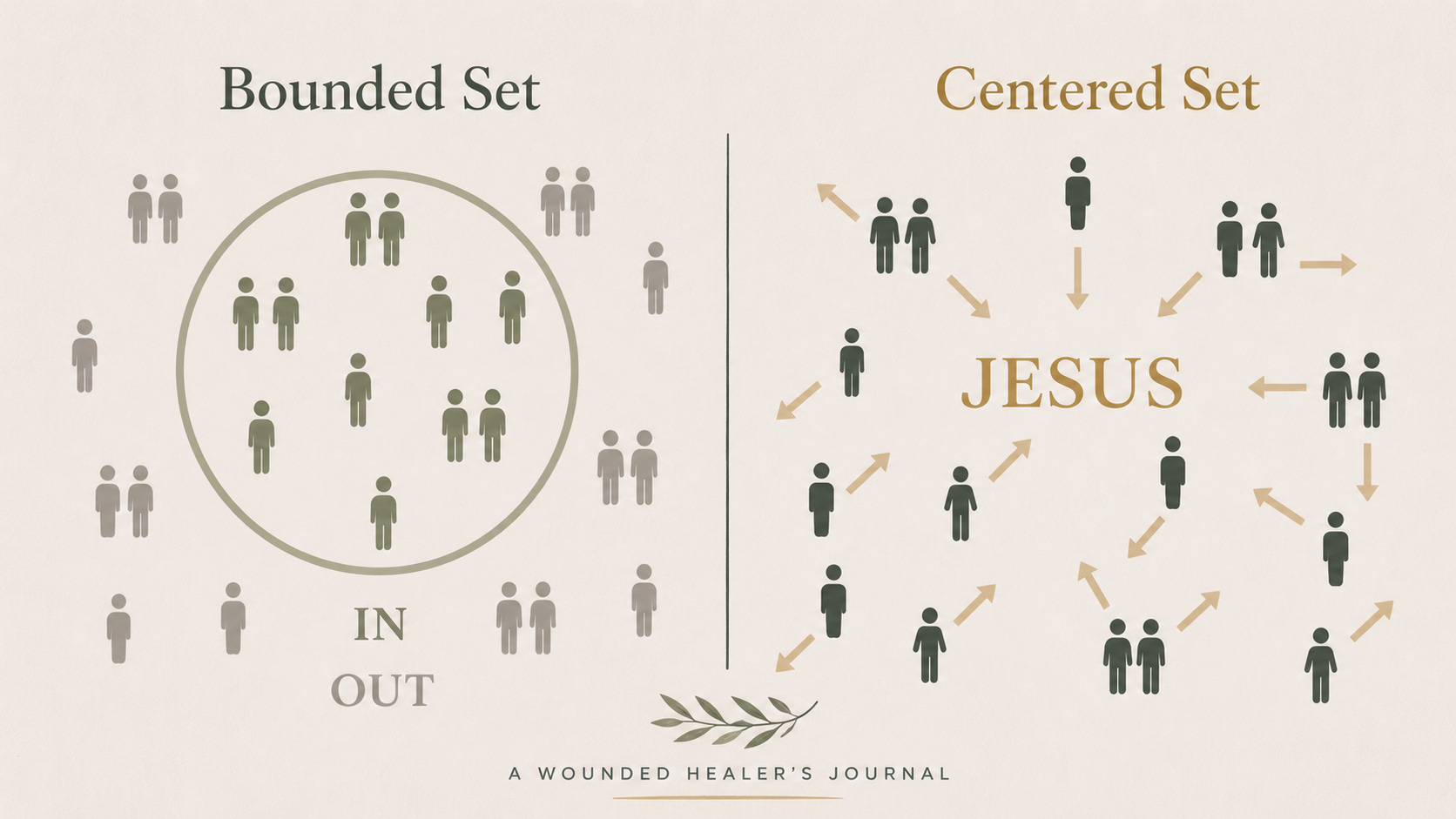
A bounded-set church spends most of its energy deciding who is in and who is out. It protects the edges. It polices the lines. It asks people to prove they belong before they are treated as family.
A centered-set church keeps asking a different question. Are we moving toward Jesus together? That does not mean anything goes. It does not mean truth disappears. It does not mean harm is ignored. It means the center is not our comfort, our culture, our politics, our preferences, or our need to be surrounded by people who already make sense to us.
The center is Jesus. And around Jesus, people who are different from one another begin to discover that they are held by the same love.
That is what the table is supposed to teach us.
But the table has to become more than a moment in worship. It has to become a way of life.
If we receive the bread and cup, then go back to protecting our circles, avoiding discomfort, and keeping people at the edge of our lives, something is broken.
Not just in our hospitality. In our imagination.
Belonging Takes Time
“The optimal way to build community is face to face, over time.”
— Lee & Fosua
You cannot microwave family.
This is the part that makes belonging difficult. It takes time.
A church can create an event quickly. It can design a program quickly. It can launch a campaign quickly. It can print signs, build a website, organize a welcome team, and teach people to smile at the door.
But family takes longer.
Belonging grows at the speed of presence.
It grows when people linger.
When stories are shared.
When someone remembers your name.
When someone notices you were gone.
When there is room to say, “I’m not okay,” without everyone panicking or trying to fix you too quickly.
When meals last longer than necessary.
When people pray for each other and then check in later.
When the church calendar leaves enough breathing room for actual relationships.
That sounds simple. It is not.
Most churches are not built for that kind of slowness. We are built for production. We know how to schedule, announce, promote, and evaluate. We know how to count attendance. We are less practiced at noticing tears, repairs, reconciliations, and quiet moments of courage.
But belonging does not happen because a church is busy.
Sometimes busyness keeps belonging from happening.
People do not need more religious activity as much as they need a people who can stay present long enough for love to become believable.
Belonging Requires Stories
“Community is where we are both wounded and healed.”
— David Kim
People do not become family by sharing a room.
They become family by sharing their lives.
One of the strongest things Kim names is the ache to be seen, known, and included. He writes about people who are surrounded by relationships and still feel deeply alone. That is the part we sometimes miss.
Loneliness is not always the absence of people.
Sometimes loneliness is the absence of being known.
You can have people around you and still feel hidden.
You can sit in church every week and still feel unseen.
You can join the group and still keep your real life folded up inside you because you are not sure the room can hold it.
This is why belonging requires stories.
Not dramatic vulnerability for effect.
Not forced sharing.
Not everyone spilling everything at once.
Just the slow, honest work of letting ourselves be known.
Where we came from.
What we carry.
What we hope for.
What has hurt us.
What we are still learning.
This is one reason churches can stay shallow even when people have known each other for years. We can know names without knowing stories. We can know roles without knowing wounds. We can know opinions without knowing fears.
And when stories are missing, stereotypes fill the gap.
That person becomes “the conservative one.”
That person becomes “the progressive one.”
That person becomes “the divorced one.”
That person becomes “the new family.”
That person becomes “the one who complains.”
That person becomes “the one who never helps.”
That person becomes a category.
Belonging begins when stories disprove our categories.
Not because stories excuse everything, but because stories help us realize we are not alone.
“What? You too? I thought I was the only one.”
— C.S. Lewis
It is harder to dismiss someone once you have heard what they survived.
It is harder to fear someone once you have eaten with them.
It is harder to keep someone at the edge once their grief has a name.
That is not sentimentality.
That is incarnation.
Love has to take flesh somewhere.
Belonging Does Not Erase Difference
“How each of us comes to feel about our individual uniqueness has a strong influence on how we feel about everyone’s uniqueness,” Fred Rogers once said—“whether we grow into adults who rejoice in the diversity of the world’s people or into adults who fear and resent that diversity.”
— Gregg Behr
The goal is not sameness. The goal is communion.
Belonging does not mean pretending our differences do not matter.
They do.
Race matters.
Class matters.
Politics matter.
Gender matters.
Disability matters.
History matters.
Power matters.
The ways people have been harmed matter.
The ways Scripture has been used to exclude people matter.
The ways church culture has centered certain people and sidelined others matter.
Belonging is not a blanket we throw over all of that so everyone feels better.
Belonging is the harder work of telling the truth and staying at the table.
It is the work of refusing both exclusion and cheap unity.
Because cheap unity says, “Let’s not talk about what hurts.”
Beloved belonging says, “We will tell the truth, but we will not use truth as a weapon to humiliate one another.”
Cheap unity says, “Let’s all be the same so no one feels uncomfortable.”
Beloved belonging says, “The Spirit gives different gifts, different stories, different experiences, and we need the whole body.”
Cheap unity says, “Keep the peace.”
Beloved belonging says, “Christ is our peace, and Christ makes peace by breaking down dividing walls.”
That kind of belonging is not easy.
It will ask more of us than politeness.
It will ask for repentance.
It will ask for listening.
It will ask for changed practices, not just softer language.
It will ask us to stop confusing comfort with love.
The Difference Between Clique and Click
“For belonging to be real, people have to have a sense of being co-owners and co-creators of the community to which they belong.”
— Irwyn L. Ince Jr.
Belonging makes room for deep friendship without closing the circle to others.
David Kim makes a helpful distinction between a clique and a click. I wish I had known that language earlier. Because churches often struggle here.
On one side, we have closed circles where nobody new can find their way in.
On the other side, we sometimes become suspicious of close friendship itself, as if real connection is somehow unfair to everyone else.
But belonging is not the death of close friendship.
Jesus had crowds.
Jesus had the twelve.
Jesus had Peter, James, and John.
That does not mean Jesus loved everyone else less. It means human life has circles of care. We cannot be equally close to everyone. We are finite. We have limits. We need particular people with whom we can be deeply known.
The problem is not when people click.
The problem is when the click becomes a clique.
A click says, “We have found a real bond, and we are grateful.”
A clique says, “This bond is ours, and others should stay outside.”
A click becomes a gift to the wider body.
A clique becomes a wall.
A click helps people become more loving.
A clique trains people to protect comfort.
The church needs real friendships. Deep ones. Honest ones. The kind where someone can say, “I’m not okay,” and not be left alone. The kind where someone can be challenged without being discarded. The kind where laughter and grief can sit at the same table.
But those friendships should make us more open, not less.
If our belonging makes us less attentive to the lonely, less curious about the stranger, less available to the person outside our circle, then it has started to bend inward.
And love always bends outward.
The Church as a Family, Not as a Club
“In this increasingly polarized political and cultural era, we hope to be a refuge of intentional hospitality and inclusion. We want people to feel free to be themselves, faithful to their own journey. Consequently, we are an affirming, inclusive community that values and embraces all who want to join our community and journey with us.”
— Brad Jersak
A club gathers around preference.
A family learns how to belong through love.
A club can be wonderful.
People join clubs because they share interests. Same hobby. Same taste. Same stage of life. Same goals. Same assumptions.
But the church is not a club.
Or at least it is not supposed to be.
A club is built around affinity.
A church is built around Christ.
A club can say, “These are our kind of people.” The church has to say, “These are God’s beloved people, and somehow, by grace, they are ours.”
It means the person who does not naturally fit may be exactly the person through whom Christ wants to stretch us.
It means the person whose story unsettles us may be the person who helps us see a fuller picture of grace.
It means belonging is not only about whether I feel comfortable. It is also about whether I am willing to be changed by love.
That is hard for me.
I like my familiar circles too.
I like people who understand me quickly.
I like spaces where I do not have to translate myself.
Most of us do.
So when I write about belonging, I am not writing as someone who has mastered it. I am writing as someone who still feels the pull of the safer table.
The one where people already know the rules.
The one where nobody asks too much of me.
The one where I do not have to confront the limits of my love.
But Jesus keeps inviting us to a bigger table.
A table where belovedness comes first, and because belovedness comes first, belonging becomes possible even when difference remains.
Becoming a People Who Make Room
“The Christian life is not just difficult to do alone. It’s impossible.”
— David Kim
Belonging becomes real when people no longer have to change to fit-in.
So what would it look like for a church to practice belonging?
Maybe it starts small.
A few people learn to linger.
Someone tells the truth after years of smiling.
A Sunday school class makes room for questions instead of rushing to the “right” answer.
A church meal becomes more than food on tables.
A newcomer is not only greeted, but invited into someone’s life.
A person on the margins is not treated like a ministry project, but like a member of the family.
A challenging conversation happens without contempt.
Someone says, “I was wrong.”
Someone else says, “I’m still here.”
That is how belonging begins to take flesh.
Not all at once. Not perfectly.
But in ordinary practices that tell the truth of the gospel with more than words.
You belong here.
Not because you are the same as us.
Not because you have figured everything out.
Not because you can help us grow the church.
Not because you know how to perform the right kind of faith.
You belong because you are beloved.
And if you are beloved by God, then the church has to learn how to receive you as family.
Maybe the future of the church will not be found first in better branding, bigger platforms, or more impressive programs.
Maybe it will begin with a slower, braver question:
Can we become the kind of people with whom others can truly belong?
Not just attend.
Not just observe.
Not just sit politely near the edge.
Belong.
At the table.
In the story.
As family.
Let’s Chat
When have you felt the difference between being welcomed and truly belonging?
What practices help a church become family instead of simply an event people attend?
Who might your church need to make room for, not as a guest, but as part of the body?
Next in the Series
Series note: This is Essay 2 of 5 in the series Being the Church Together. We began with belovedness, the truth that every person is loved by God before they prove anything. Today we moved from belovedness into belonging, asking what it would mean for the church to become a family where people are known, received, and held across real difference.
Preview for next essay: Essay 3 turns toward Becoming Together. Belonging is not the end of the path. It is the soil where transformation begins. What if discipleship is not becoming more religious, but becoming more fully human in Christ, together?
”Salvation is best understood as a kind of belonging.
To be saved is to belong to and participate in the kingdom of God,
a kingdom where Jesus is King (Christ).”
— Joseph Beach
”The words community and family describe the church well. Church isn’t merely an idea. It is the interconnected relationships of people: real people, fallible people, different kinds of people. The challenge of community is learning to love people who aren’t like us, and out of this challenge comes deep formation in the ways of Jesus.”
— Derek Vreeland
“You deserve belonging, beloved. You need community. You need siblings and friends, mothers and fathers whether by blood or by choice, saucy aunties and casual acquaintances to remember our names at the coffee shop, and you still need some way to give and some way to receive. Life will always be a communal experience. And even if you don’t identify as a Christian any longer, you still need people. You need your people. However it looks, I think the question to ask is less about finding a new church and dealing with the fallout from your old church or wherever you find yourself spinning out right now. Rather, ask yourself, Where am I finding belonging right now? And where can I create belonging for others, too?“
— Sarah Bessey
Amen! A microwaved family is often soggy, over or under cooked and tastes off…or worse…just plain bad.
I yearn for belonging to a community with Jesus at the center. I do have a group of people on Facebook that I met at a Neil Kramer presentation years ago. But we all live so far away.
By the way, do let us know how your surgery went 🙏🏼