



All Means All
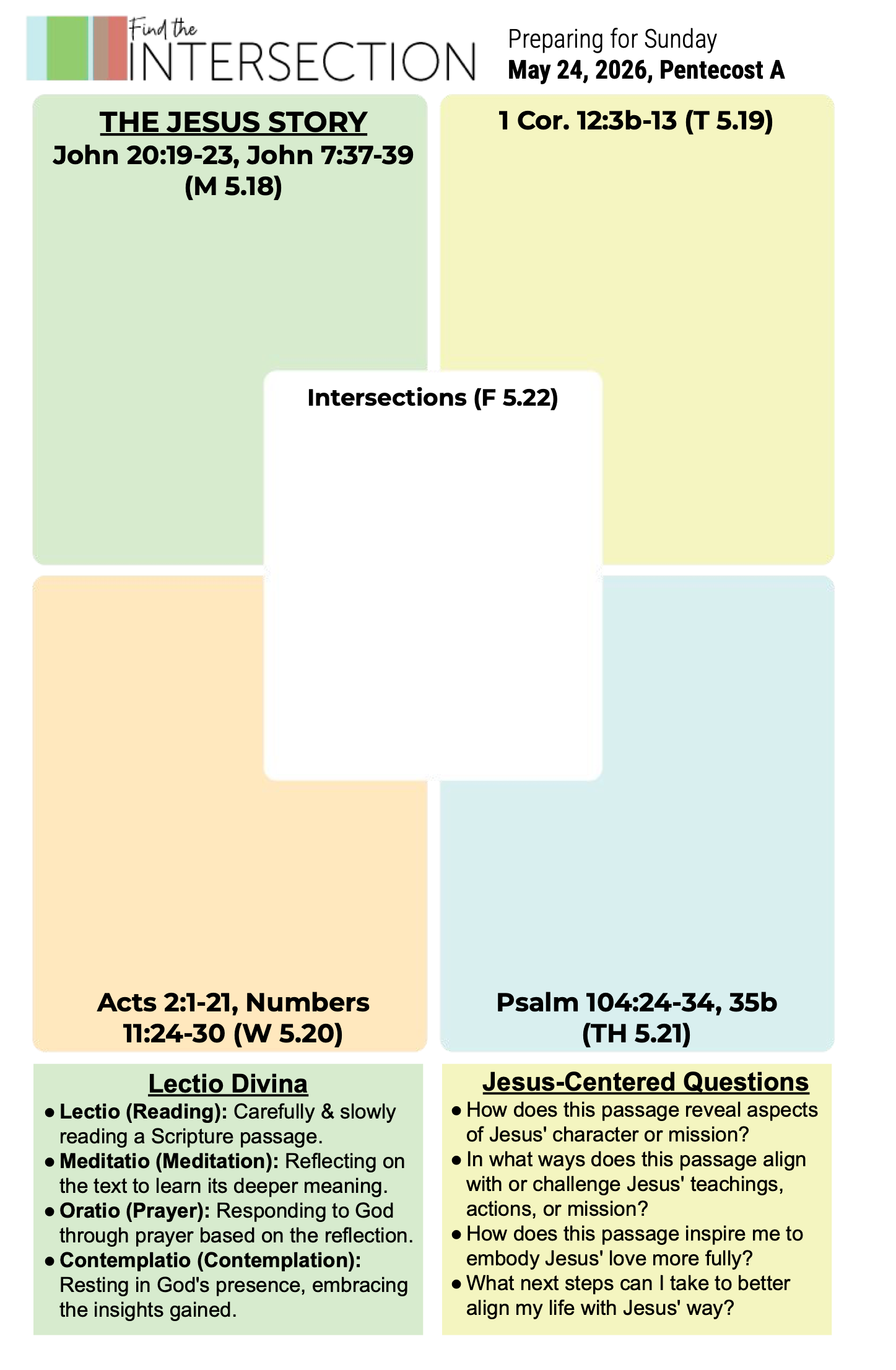
Wednesday 5.20.26 - Acts 2:1-21; Numbers 11:24-30 (Pentecost A)
When God says all flesh, the circle gets wider than we expected.
TL;DR: Numbers 11 gives us Moses’ old wish: that all God’s people would receive the Spirit. Acts 2 says that wish has started coming true. The Spirit is poured out on all flesh, not just the people at the center, and the church has to learn the difference between faithful discernment and anxious control.
Read Acts 2:1-21; Numbers 11:24-30
The Spirit Will Not Be Contained
I think a lot of us like the idea of the Holy Spirit as long as the Spirit behaves.
We want the Spirit to comfort us, guide us, help us make wise decisions, and maybe give us enough courage to get through the day. That part feels manageable.
The trouble starts when the Spirit speaks through people we did not expect. People outside the usual circle. People without the right credentials. People whose voices make the room less predictable. People we are used to helping, but not used to hearing. That is where Pentecost gets interesting.
Because in Acts 2, the Spirit does not arrive quietly and stay tucked inside private religious experience. The Spirit comes like wind. The Spirit rests like fire. The Spirit gives speech. The Spirit makes the good news understandable across languages and borders and backgrounds.
People are amazed. People are confused. Some people mock it because mocking is easier than listening.
And Peter stands up and says, this is what the prophet Joel was talking about.
All flesh.
That is the phrase that sticks with me.
All flesh.
All
All means all.
Moses Was Exhausted
Before we get to Acts 2, the lectionary takes us back to Numbers 11.
Moses is not having a great leadership day.
The people are complaining in the wilderness. They are tired of manna. They are remembering Egypt through the strange fog of nostalgia, as if slavery came with a better menu. Moses is done. He tells God, in so many words, “I cannot carry all these people by myself.”
That might be one of the most honest leadership prayers in the Bible.
I cannot carry this alone.
God does not shame Moses for saying it. God does not tell him to toughen up, pray harder, or develop a better productivity system. God shares the burden.
The Spirit that rests on Moses is given to seventy elders, and they prophesy. Leadership becomes less centralized. The burden becomes less crushing. The community gets more than one Spirit-filled person.
That is already beautiful.
Then the story gets even better.
Two men, Eldad and Medad, start prophesying in the camp. They were not with the official group at the tent. They were not where they were supposed to be, at least not according to the expected structure.
Someone runs to tell Moses.
Joshua wants them stopped. And honestly, I understand Joshua. Most of us do. We like order. We like clarity. We like knowing who is allowed to speak, where they are allowed to speak, and who gave them permission.
Unexpected Spirit activity can feel like a problem if we are used to managing God.
Moses sees it differently.
“Would that all the Lord’s people were prophets, and that the Lord would put his spirit on them!”
Moses is not threatened by shared Spirit. He sounds relieved.
All Flesh Means All Flesh
That old wish of Moses echoes into Acts 2.
The disciples are gathered. The sound of wind fills the house. Tongues as of fire rest on each of them. They begin to speak in other languages as the Spirit gives them ability.
The crowd hears the good news in their own native languages.
Pentecost is not the Spirit making everyone sound the same. Pentecost is the Spirit meeting people in language they can understand. That is such a generous miracle.
The Spirit does not erase difference. The Spirit honors people enough to be understood by them.
Then Peter reaches for Joel:
Your sons and your daughters shall prophesy.
Your young men shall see visions.
Your old men shall dream dreams.
Even upon enslaved men and women,
God says, I will pour out my Spirit.
Peter does not say the Spirit is poured out on the impressive.
He says all flesh.
He names daughters in a world that often centered sons.
He names the old and the young in a world where age could be used to dismiss people in different directions.
He names enslaved women and men in a world that treated some bodies as property.
This is a holy disruption.
The Spirit gives voice to people the world has learned how to manage.
Pentecost for the Overlooked
I wonder who we would be tempted to stop.
Who sounds too young to us?
Who sounds too wounded?
Who sounds too angry?
Who sounds too poor, too unpolished, too emotional, too disabled, too complicated, too new, too old, too outside the room where decisions usually get made? Who have we welcomed as long as they stayed grateful and quiet? Who have we served without ever imagining we might need to listen to them?
That is where Pentecost starts pressing on the church. It is one thing to say the Spirit is poured out on all flesh. It is another thing to believe the Spirit might speak through flesh we have been trained to overlook.
And to be clear, not every voice is automatically right. Not every claim is holy because someone says it with passion. Peter still interprets the moment through Scripture. The community still needs discernment.
But discernment and control are not the same thing.
Discernment listens for the Spirit. Control protects the usual center.
Discernment asks what God might be doing. Control asks who allowed this.
I know which one comes more naturally to religious systems.
I know which one comes more naturally to me.
The Week So Far
This whole Pentecost week has been building toward something.
On Monday, John gave us water and breath. Jesus came to thirsty people and frightened people. He stood in a locked room and gave peace before anyone looked brave.
On Tuesday, Paul reminded us that we are one body with many members. We do not have to be the whole body, and we do not get to treat anyone else like they are nothing.
Today, Acts and Numbers tell us what happens when the Spirit gives voice to the body.
The breath becomes speech. The water begins to flow. The members start to prophesy. The people at the edge of the camp are not as far from God as some people assumed.
That is good news. It is also a little unsettling. Because once the Spirit gets out, the church has to change how it listens.
When Ordinary People Start Prophesying
I keep thinking about Eldad and Medad in the camp. They were not where everyone expected the Spirit to show up. Still, the Spirit found them.
That feels like Pentecost to me. The Spirit in the locked room. The Spirit in the body. The Spirit in the camp. The Spirit in the languages of people far from home. The Spirit on daughters and sons. The Spirit on old dreams and young visions. The Spirit on servants whose voices powerful people were used to ignoring.
Maybe Pentecost is not only the birth of the church.
Maybe Pentecost is the widening of the room.
God makes space for more voices than we know how to manage.
God pours out Spirit where our systems would have poured out suspicion.
God keeps choosing people we would have kept waiting for permission.
So maybe the invitation today is simple, though not easy. Listen wider. Make room. Do not confuse your discomfort with God’s disapproval. Do not call something disorder just because it did not start at the center.
The Spirit gets out. And when the Spirit gets out, people who were told to stay quiet begin to speak of the mighty works of God.
Reflect
Whose voice are you tempted to dismiss because it comes from outside the expected center?
Where do you confuse discernment with control?
Who has God used to speak truth to you in a way you did not expect?
What would it look like for your church, family, or community to make room for “all flesh”?
Prayer
Spirit of the living Christ,
Teach me to listen wider.
Free me from the need to manage every place you move.
Give me discernment that is humble enough to recognize your voice in unexpected people.
Make our churches brave enough to honor sons and daughters, old and young, centered and overlooked.
Pour your Spirit on all flesh,
And make us faithful enough to receive the voices you raise up.
Amen.
I laughed out loud when I read; "
I think a lot of us like the idea of the Holy Spirit as long as the Spirit behaves."
I laughed because it is so true.
Here's the bottom line with that issue in community life; of who gets to be heard. If you want God more than anything else you will genuinely want anyone who thinks they may have something from God to share to be heard. And if you just want to fit into your social group, you will get very particular.
Listen to what Jesus says after He has reamed out the religious leaders of His day for their godless lives, for their hypocrisy.
Matthew 23:37 O Jerusalem, Jerusalem, thou that killest the prophets, and stonest them which are sent unto thee, how often would I have gathered thy children together, even as a hen gathereth her chickens under her wings, and ye would not!
:38 Behold, your house is left unto you desolate.
:39 For I say unto you, Ye shall not see me henceforth, till ye shall say, Blessed is he that cometh in the name of the Lord.
What Jesus did not say was You will not see henceforth until you say blessed is he who comes from this particular school of thought, or blessed are those who carry real credentials to speak. Blessed are those who come from First Baptist Church.
No, He leaves it unqualified, and does, not because the listener will not eventually determine if the person coming in the name of The Lord did actually come with something from God. They bless them at the beginning in the hope that they do have something from God because they are just so hungry for more of God that they have left behind all of their egotistical, pride-driven requirements.
And Jesus is saying to us today, as much as he was saying this to people of His day, that this is a deal-breaker for God. If you dearly want more of God, you will leave your prideful stipulations at the door and look for God in absolutely anyone who says they have something from God for you.
Do you do this?
What stipulations do you add? What does your list of people you will listen to look like? Think about this one carefully, because we all have a prideful list. I do, even as I post this. I am not aware of where that pride is lurking, but God keeps showing more of my pride, so I can extrapolate that there is very likely much more of the crap in me.
God is not trying to label some of us as good people and some of us as bad people in raising these issues. He is, instead, calling us into a bigger, more peaceful, joyful, and contented life.
Thank you! We need to listen to the Spirit. We need to discern. As we discern, we need to welcome and listen more.